Waymo and Zoox are running driverless fleets in Miami, Orlando and Tampa. Tesla is building a car it can’t legally sell, can’t fully drive, and won’t put on the road in numbers. That isn’t caution. That’s a verdict.
Analysis by Brian French Published August 12, 2026 · Tampa, FL
Filed under: Autonomous Vehicles · Florida Transportation · Tesla · Waymo · Zoox
The Verdict
Tesla has lost the autonomous vehicle race. Not “is falling behind.” Not “faces headwinds.” Lost.
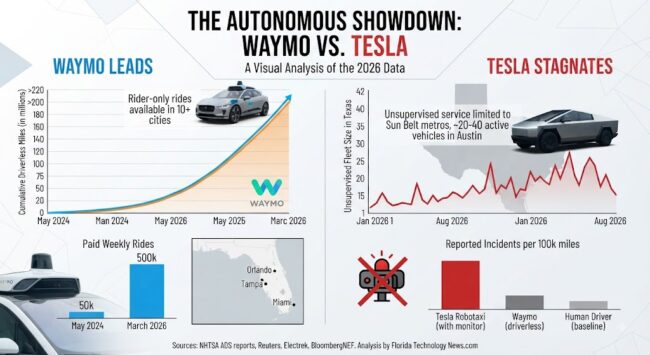
Waymo is carrying paying passengers in Miami and Orlando, went driverless in Tampa in July, and moves roughly half a million paid riders a week nationally across a fleet near 4,000 vehicles. Amazon’s Zoox is running a purpose-built pod with no steering wheel and started charging fares in Las Vegas on August 10. Tesla, fourteen months after its Austin launch, is operating somewhere around twenty driverless cars in its home market — cars that a human in a control room can seize the wheel of, remotely, when the software gives up.
The company won’t scale it. That refusal is the most honest thing Tesla has told the public about Full Self-Driving in a decade. A firm that manufactures two million vehicles a year and cannot bring itself to field fifty driverless cars in the one city it has mapped, rehearsed and validated for over a year is not being prudent. It is telling you, through its own capital allocation, that the technology does not work well enough to bet on.
Meanwhile the Cybercab line at Giga Texas keeps running, stacking up steering-wheel-less two-seaters that have no legal buyer and no autonomous stack ready to drive them.
This piece lays out how it happened, why the vision-only architecture cannot be rescued, and why the Florida rollout is the clearest evidence yet.
About the Author
Brian French is the owner and publisher of the Florida Authority Network news platform and writes extensively on technology, covering autonomous vehicles, transportation, and the companies reshaping how Floridians move.
Before turning to publishing, he spent his career on Wall Street as a money manager and stock analyst — a background that shapes how he reads this beat. Analysts are trained to separate an operating metric from a marketing metric, to ask who chose the benchmark and why, and to notice when every methodological choice in a disclosure happens to break the same way. That is exactly the skill this story demands, which is why he spends more time than is probably healthy inside NHTSA Standing General Order filings, state DMV disclosures, and the footnotes of quarterly safety reports.
He has tracked the robotaxi sector since the earliest Waymo permit applications in Arizona and writes from the Tampa Bay area, where three rival driverless services now operate within a few miles of one another. He holds no position in Tesla, Alphabet or Amazon and takes no money from any autonomous vehicle company.
Florida Is the Scoreboard, and Tesla Arrived Last
You no longer have to adjudicate this argument from press releases. You can adjudicate it from a Tampa sidewalk.
Waymo opened paid public service in Miami on January 22, 2026, across sixty square miles taking in the Design District, Wynwood, Brickell and Coral Gables, with fleet operations handled by the specialist firm Moove. Roughly ten thousand South Floridians had signed up before the first fare was collected. It was not an experiment dropped on an unfamiliar city — Waymo had run vehicles through Miami as far back as 2019 specifically to develop wet-weather capability, then returned with years of additional work behind it.
Orlando followed on February 24. On April 15 both Florida markets opened to the general public, with select Miami riders granted opt-in access to freeway trips.
Tampa Bay came next. Waymo began local testing in December 2025 with employees behind the wheel, then announced on July 8, 2026 that its Tampa fleet would go fully driverless, alongside San Diego, Las Vegas and Denver. The service footprint runs from Sweetwater Creek and Del Rio out to West Shore and Palmetto Beach. Before flipping the switch, the company spent months training on local roads and coordinating with MADD Florida, The Arc Tampa Bay, Foundation Fighting Blindness and OnBikes. Tampa firefighters ran drills with the vehicles.
Zoox has been in Miami since 2024 with a retrofitted Highlander test fleet, feeding data to a purpose-built robotaxi that has no steering wheel, no pedals and no driver’s seat. Across Las Vegas, San Francisco, Miami and Austin, the Amazon subsidiary has logged more than three million public-road miles and carried close to a million riders. On August 5 it announced its first paid market.
Then there is Tesla, which switched on Robotaxi service in Tampa and Orlando the day before its Q2 earnings call.
Consider the timing on its merits. A geofence is a configuration change. Announcing a market on the eve of an earnings call is a communications decision. Neither requires the underlying technology to have improved by a single percentage point. What the moment demanded — what any serious operator would have done with a working product — was saturating Austin. Tesla did the cheap thing instead.
The Tampa experience matched the theory. A CleanTechnica writer spent an hour on Tuesday, July 21 trying to hail a Tesla Robotaxi and got nothing but the app’s “High Service Demand” notice, the message that appears when requests outnumber available cars. He got a ride Sunday at noon in light traffic. His verdict on the Tampa Bay service area was that it covered roughly five percent of where he’d actually want to go and would need hundreds of vehicles to be competitive.
Florida did not welcome a robotaxi network in July. It welcomed a demo.
🔎 Brian’s Take #1
I spent enough years reading company disclosures to know that the interesting number is never the one in the headline. Tesla’s headline number is cities. Six, seven, eight metros — the map keeps getting more pins. The interesting number is cars per metro, and it’s brutal. Waymo went from fifty thousand to five hundred thousand paid weekly rides in under two years and put four thousand vehicles on American roads. Zoox built a vehicle from scratch, with no steering wheel, and is taking money for rides. Tesla lit up two Florida markets on the eve of an earnings call and then couldn’t answer a Tuesday afternoon ride request. When a company starts reporting geography instead of volume, it’s because volume is the number that hurts. Every analyst who has covered a struggling business recognizes that substitution immediately.
The Twenty-Car Mirage: What Austin Actually Is
The obvious objection to everything above is that twenty cars work. If twenty work, why not two thousand?
Because those twenty are not twenty autonomous cars. They are twenty cars with humans attached, and the humans do not come free.
Tesla admitted the architecture in writing. In correspondence with Senator Ed Markey, Karen Steakley — Tesla’s director of public policy and business development — confirmed the company staffs Remote Assistance Operators at facilities in Austin and Palo Alto to monitor the Robotaxi fleet. Those operators can assume direct control of a vehicle at speeds up to 2 mph, and, where the onboard software permits based on surrounding conditions, can remotely drive the car at up to 10 mph. Tesla characterizes this as a last-resort escalation after other interventions are exhausted. At launch, Musk’s stated target was roughly one remote operator for every twenty cars.
Sit with that ratio, because it is the entire scaling problem in a single figure.
One human per twenty vehicles is a payroll line that grows in lockstep with the fleet. Two thousand cars implies a hundred operators on shift simultaneously, staffed around the clock across three shifts, plus supervisors, plus facilities, plus redundant connectivity, plus the hiring and training pipeline to keep the seats filled. That is not software leverage. That is a labor-intensive services business wearing a technology company’s valuation.
And Tesla chose the expensive version of remote assistance. Waymo’s remote staff work advisory: the vehicle poses a question — is this street with emergency vehicles passable? — a human answers, and the autonomous system retains control of the actual driving. One person can field those queries across many vehicles because each interaction is brief and asynchronous. Tesla’s operator physically pilots the car, which makes that person the driver for the duration of the handoff. One operator, one car, undivided attention. It scales in precisely the wrong direction.
Both confirmed Austin teleoperator crashes occurred during those handoff moments. The crutch is itself a failure mode.
There is more sanding of the edges. The Austin fleet ran invite-only. The original geofence was drawn to avoid complex intersections. Service hours run roughly 6 a.m. to 2 a.m. Availability has been reported near nineteen percent. Chase cars trailed the early vehicles. Operations paused during a January ice storm. Every one of those constraints exists to keep the vehicle inside the envelope where the software performs — and every one of them dissolves the moment you promise a citywide service where anyone can summon a car to anywhere at three in the morning during a squall.
Then there is the deepest reason twenty cannot become two thousand, which is statistical rather than operational. A small fleet inside a small geofence samples a thin slice of the world. The events that break autonomous systems are the rare ones: a dark traffic signal, an improvised construction diversion, a child stepping out from between parked cars into low sun. Across eight hundred thousand miles you meet a handful. Across eighty million you meet them weekly, in combinations no engineer scripted. Waymo’s 220 million rider-only miles are not a vanity statistic. They are the only known method for finding those cases before a passenger does.
Scale a system that already crashes more often than humans and you don’t get a business. You get a multiplier on your worst week.
The Hesitation Is the Confession
Here is where the argument stops being about sensors and starts being about what Tesla’s own behavior reveals.
Nine months after Austin went live, Tesla had twenty-five unsupervised vehicles and fourteen logged crashes, and Musk had tied any meaningful ramp to FSD v15 — an architectural overhaul targeted for late 2026 at the earliest and early 2027 at the latest. The centerpiece of v15 is scale: growing the driving neural network from roughly one billion parameters to about ten billion, a change Musk has called a major architectural improvement.
Read that as an analyst would read a management disclosure, not as a fan would read a roadmap.
If the current software were adequate, you would not gate expansion on a rewrite. You would ship cars. The decision to hold the fleet flat while promising a tenfold parameter increase is management telling the market, in the politest available language, that the deployed stack cannot carry the business. Companies do not delay revenue they are capable of capturing.
The second admission is worse and got less attention. Musk conceded that the Hardware 3 platform installed in a substantial share of Tesla’s global fleet lacks the memory bandwidth required for unsupervised operation and cannot be upgraded without replacing both the compute unit and the cameras. That sentence quietly euthanizes the founding promise of the entire program — that millions of customer-owned Teslas would one day wake up as revenue-generating robotaxis. They will not. Not without a hardware retrofit Tesla has never committed to funding at scale, on cars sitting in driveways from Pensacola to Key West whose owners paid thousands of dollars for a capability that is now conditioned on parts that don’t exist in their vehicles.
Notice the shape of the pattern across a decade. Autonomy always arrives one version from now. The version ships, falls short, and autonomy moves to the next version. v12 was going to do it, then v13, then v14 produced a tracker improvement that analysts called the largest in four years — and Tesla still didn’t scale. Now v15. Each rewrite is presented as the final piece. Each one relocates the finish line.
That is not a learning curve approaching an asymptote. It is a company discovering, repeatedly, that the remaining distance is longer than the distance already traveled. Full Self-Driving in its current form is not a product nearing completion. It is a research program that has been sold as a product for eleven years, and the bill is coming due.
🔎 Brian’s Take #2
In money management you learn to watch what a company does with its own capital, because that’s the one signal nobody can spin. Tesla has the balance sheet to put a thousand cars in Austin tomorrow. It builds the cars. It owns the factory in that city. It has the regulatory permission. It has fourteen months of local mapping and validation. It has every incentive — competitive, financial, reputational — to flood the market and prove the doubters wrong in a single quarter. It hasn’t. When a company with the means, the motive and the opportunity declines to act, you don’t need a leaked memo to understand why. Management has seen the internal data and drawn the conclusion the public hasn’t been given yet. The hesitation is the confession.
Lidar: The Mistake That Can’t Be Unmade
In 2019 Musk called lidar a fool’s errand and said anyone relying on it was doomed. That line has become the most expensive sentence in modern automotive engineering.
Every operator running driverless commercial service at scale — Waymo, Zoox, Nuro, the major Chinese players — fuses cameras, radar and lidar. Not one has achieved it on cameras alone. That is not fashion. It is a physics result that keeps reproducing.
Cameras infer depth from learned priors. Lidar measures it directly. Cameras collapse in sun glare, heavy rain, road spray, fog, and low-contrast scenes where a gray object sits against gray pavement. Radar punches through weather but resolves poorly in angle. Lidar returns geometry that doesn’t care about ambient light. Fuse all three and a failure in one channel is caught by the others. Run cameras alone and every perception failure is unarrested.
Florida drivers know this in their bodies without knowing the terminology. Anyone who has driven I-4 into an August wall of water, or crossed the Howard Frankland with the sun sitting exactly on the horizon, understands what a camera-only stack is being asked to do. Tesla’s answer to those conditions is eight cameras and a windshield wiper.
Musk’s defense rested on three claims: humans manage with two eyes, lidar is too expensive, and sensor fusion breeds ambiguity. Two have collapsed outright. Lidar unit costs have fallen more than an order of magnitude since 2019, to the point where sensing is nowhere near the binding constraint on robotaxi economics — depreciation, remote assistance labor, cleaning and depot operations dominate the cost stack. And the two-eyes analogy was always a rhetorical trick: humans also bring general world knowledge, a neck that swivels, and the judgment to slow down when visibility fails. A network trained on video clips brings none of that.
What remains is philosophy. Philosophy does not appear in a crash-per-mile table.
The cruelty of this particular error is that it compounds and cannot be reversed cheaply. Every Tesla built since 2019 carries the wrong sensor suite for the mission. Adding lidar now means new hardware, new calibration, new training pipelines, new validation — and a public admission that the founding technical thesis was wrong. The longer the company waits, the larger the fleet it would have to disown.
The Safety Numbers Were Built to Mislead
For years Tesla has told the public its systems are roughly ten times safer than human drivers. That claim has now been dismantled by journalists, academics and federal legislators, and what’s left is not a disagreement about interpretation. It is a demonstration that the comparison was constructed to produce a predetermined answer.
Reuters published the definitive examination on May 28, 2026. Its review identified multiple invalid comparisons underpinning Tesla’s FSD safety report, and of eleven traffic-safety researchers who assessed the methodology, ten called it misleading marketing rather than genuine safety investigation. The central defect: Tesla measures crashes in FSD-piloted vehicles that were severe enough to deploy airbags, then benchmarks that against a federal crash rate covering all vehicles including far less severe collisions. It also compares its cars against the average American vehicle, which is substantially older.
Translated: count only your bad crashes, compare to everyone else’s bad and minor crashes, attribute the gap to your software.
A Senate oversight letter to NHTSA flagged the identical flaw, noting Tesla compared its own airbag-deployment crashes against federal data tracking crashes in which a vehicle was towed from the scene — a much broader category.
The problems stack. The methodology is self-reported. Raw crash counts and vehicle miles traveled are never disclosed. Autopilot figures draw disproportionately from limited-access highways, the safest road class in America, while the federal baseline blends all road types. It is not Autopilot versus humans but Autopilot plus a supervising human versus humans, with no accounting for how many crashes those supervising humans prevented. And Tesla owners skew newer-vehicle, higher-income and tech-enthusiast — a demographic with lower baseline crash risk before any software is involved.
Here is the analyst’s tell, and it is decisive: every one of those distortions runs the same direction. Genuine methodological sloppiness produces errors that scatter. Errors that all point at the same conclusion are not errors. They are a design.
The view from inside is no better. Reuters interviewed nine former Tesla data labelers — the workers who train the system by reviewing footage from the eight exterior cameras — and seven said they would not trust FSD to drive them. A veteran self-driving engineer who spent years reviewing Tesla crash data called the company’s safety claims worthless in blunter language. The labelers described watching vehicles strike cats, dogs and deer, sometimes without braking before impact, routinely speeding, occasionally near-missing children in the street.
The people who see the most footage trust the product the least. That is not a detail. That is the review.
🔎 Brian’s Take #3
Compare the disclosure postures and the race explains itself. Waymo, Zoox, Aurora and Nuro all file complete narrative crash descriptions with federal regulators. Tesla is the only major operator that redacts every single one as confidential business information. So the public record shows that a Tesla robotaxi struck a cyclist — and then a black bar. Ask who that black bar protects. Not riders. Not regulators. Not the cyclist. Now put it in a Florida frame: autonomous ride-share is regulated in Tallahassee, not by Tampa or Miami city hall. If something goes badly wrong on Bayshore Boulevard, a city council can’t pull a permit — the state can, and it would do so for every Florida market at once. What would state regulators be reviewing when that day comes? A redaction. Tesla has spent two years ensuring that nobody outside the company can evaluate its failures, and it will spend the crisis discovering why that was a mistake.
What the Federal Filings Actually Show
Set aside the marketing and read the mandatory disclosures.
NHTSA filings reviewed by Electrek showed fourteen documented collisions involving Tesla’s Robotaxi service since Austin began operating in June 2025 — among them a 17 mph impact with a fixed object, a collision with a bus while the Tesla sat stationary, a 4 mph impact with a heavy truck, and two reversing incidents into a pole or tree. Against roughly eight hundred thousand fleet miles, that is about one crash every 57,000 miles: roughly four times worse than the benchmark Tesla itself publishes for average drivers. Measured against NHTSA’s standard of one police-reported crash per 500,000 miles, the gap approaches ninefold. Even on the most charitable framing — including unreported fender-benders, putting humans near one crash per 200,000 miles — Tesla still runs about three and a half times worse.
Every mile in that sample was driven with a safety monitor aboard whose entire function was preventing crashes.
Head to head, a comparison of NHTSA incident reports put Tesla Robotaxis at roughly one crash per 62,500 miles against Waymo’s one per 98,600 — with Waymo running fully driverless and Tesla running monitors. A fault-attribution analysis reaches the same destination by another road: Waymo is at fault in only twelve to fifteen percent of its reported incidents and is frequently struck while stopped, a signature of enormous operational mileage, while Tesla’s smaller crash count carries a higher at-fault share even under supervision.
And the institutional comparison that says the most: Waymo documented more than thirteen million California test miles across a decade before earning its commercial driverless permit there. Tesla has logged 562 California autonomous test miles since 2016.
Five hundred sixty-two.
Waymo is not flawless and Florida readers shouldn’t be handed that story either. Its vehicles have driven into flooded roadways after severe weather. Over the Fourth of July weekend in San Francisco, several sat in traffic long enough to drain their batteries and one was filmed driving into fireworks. In Austin its cars have repeatedly and illegally passed stopped school buses. Its benchmarks draw fair criticism too: the miles concentrate on urban surface streets, skew toward daytime and fair weather, and are compared against human baselines that include many underreported minor collisions.
The distinction isn’t that Waymo is perfect. It’s that Waymo is measurable. Tesla has arranged not to be.
Building a Car It Can’t Sell and Can’t Drive
Which brings us to the strangest scene in the American auto industry, playing out right now on the outbound lots at Gigafactory Texas.
The first production Cybercab rolled off the line on February 17, 2026. Continuous production was confirmed on the Q1 earnings call in April. By July, more than a hundred of the steering-wheel-less two-seaters were visible in the yards. Tesla’s stated ambition is a sub-$30,000 vehicle produced at a rate approaching one every ten seconds at full scale, toward an eventual two million units a year.
The Cybercab has no steering wheel and no pedals. That is not a styling choice; it is the entire concept. Which means the vehicle cannot be sold to a private owner in the United States, and it cannot legally or practically operate unless the autonomous system driving it is good enough to run with no human aboard and no human able to intervene from a seat.
That system does not exist yet. Tesla has said so itself by deferring scale to v15. Musk has separately cautioned that Cybercab output will be very slow initially and that material revenue is unlikely before at least 2027.
So the company is manufacturing, at rising volume, a vehicle with no legal buyer, no complete software stack, and no deployed network to absorb it. Every unit rolling into that lot is a bet that the thing Tesla has failed to deliver for eleven consecutive years will arrive before the inventory becomes an embarrassment.
Manufacturing was never Tesla’s bottleneck. It was always the answer to a question nobody was asking. The bottleneck is a camera-only perception stack that needs a remote human on standby, that its own trainers won’t ride behind, that crashes several times more often than an ordinary driver, and that the company will not scale past twenty cars in the city it knows best.
Building the vehicle first only makes sense if you’re certain the software is imminent. Tesla’s own scaling decisions say it isn’t. The production ramp and the deployment freeze cannot both be rational. One of them is a bet placed against the company’s own evidence.
Florida Is Easy Mode, and It’s Still Going Badly
Look at where Tesla operates: Austin, Dallas, Houston, Tampa, Orlando, Miami, the Bay Area. Every market is a mild-winter metro. Waymo’s commercial footprint has skewed Sun Belt too — but the two companies are doing opposite things about it.
Waymo has been engineering for winter since 2017, running validation in Michigan, Buffalo, Truckee and the Upper Peninsula. Its sixth-generation hardware includes sensors built to shed snow. In March 2026 it released footage of vehicles operating in snow across Denver, Detroit, New York, Philadelphia, Houston and Washington. Its July driverless expansion paired Tampa with Denver in the same announcement — a warm market and a snow market, on the same software.
Tesla has announced no comparable program, because there is no sensor suite to harden. When Austin iced over in January 2026, the fleet stopped for two days.
The implication for readers here is uncomfortable rather than reassuring. Tesla’s crash rates, disengagement figures and availability numbers are all being generated in some of the easiest driving conditions in the country. That is the flattering case. Those are the good numbers. Apply Buffalo in February to a camera-only stack and the gap doesn’t narrow — it detonates.
Florida has its own hard mode, of course, and nobody has solved it. Convective storms that erase visibility in ninety seconds. Arterials that flood on a schedule. Evacuation traffic. Ybor and Wynwood at one in the morning, thick with pedestrians and scooters. Waymo has already driven into standing water after severe weather. But only one company is attempting all of it without the sensor that works when the cameras can’t see.
🔎 Brian’s Take #4
Let me be exact about the claim, because precision is what makes it stick. FSD (Supervised) is a genuinely good consumer driver-assistance product and plenty of our readers use it daily and like it. What’s doomed is the thesis — that this architecture, on this hardware, becomes unsupervised autonomy through accumulated data. That thesis is dead, and Tesla’s own conduct is the death certificate: a fleet frozen at twenty cars, a rewrite deferred to 2027, a hardware platform in millions of customer cars conceded as incapable, remote operators piloting vehicles at 10 mph, and a factory stamping out robotaxis for a network that doesn’t exist. Tesla set the terms of this race itself — a nationwide autonomous fleet, a million robotaxis, customer cars appreciating into income-producing assets. Judged on its own goal, its own timeline, its own chosen metric, it is years behind a rival it publicly ridiculed and is being lapped by an Amazon subsidiary that started later with a stranger vehicle. You don’t need a valuation model to see it. You need a calendar.
Why a Handful of Crashes Ends It
Small fleets are not merely slow. They are fragile in a way that large ones aren’t, and Tesla’s exposure here is severe.
Statistical safety arguments require volume. Waymo can survive a terrible incident because it can situate that incident within 220 million driverless miles and a published, externally reviewed methodology. One crash moves its rate by a rounding error, and regulators can evaluate the event against an established baseline. Tesla has none of that. With dozens of cars and a few hundred thousand unsupervised miles, two or three serious injury crashes in a single month wouldn’t be an anomaly in the dataset. They would constitute the dataset.
The precedent is recent and unambiguous. Cruise had a functioning commercial service across multiple cities, a fleet far larger than Tesla’s current deployment, and General Motors behind it. One pedestrian incident in San Francisco, compounded by a disclosure failure, and the permits went, the leadership went, and eventually the entire program went. The technology didn’t degrade overnight. The political tolerance did.
Tesla is more exposed than Cruise was, on four counts. Its crash rate is already worse than human drivers and worse than every peer. Its crash narratives are redacted, which means that in the seventy-two hours after a serious incident it will have no independent record to point to. NHTSA already has four active investigations into FSD and Autopilot. And its public safety claims have now been contradicted in detail by Reuters, by academic researchers, by a United States senator and by its own former employees — so the sentence “our data shows we’re safe” will not survive contact with a press conference.
Tesla also revised a July 2025 crash report to acknowledge a hospitalization after initially filing it as property damage only. In a crisis, that correction becomes the first slide in every adversarial presentation.
Florida sharpens the risk. Tampa City Council Chair Alan Clendenin has stated plainly that the state regulates ride-share operations and the city does not. Centralized authority cuts both ways: no single city council can slow a rollout it dislikes, but if Tallahassee’s posture shifts after a bad incident, it shifts for Miami, Orlando and Tampa simultaneously. Scrutiny has already begun — longtime insurance executive and gubernatorial candidate Frank Russo has called for transparency before further expansion, asking how many vehicles are planned and demanding to see the safety models and how they are evaluated.
A redacted crash narrative cannot answer either question. That is the position Tesla has built for itself in the state where it just launched two markets.
The Bottom Line
The strongest case for Tesla goes like this: Waymo’s economics don’t scale, each of its vehicles is an expensive hand-built asset requiring per-city mapping and remote staffing, while a Tesla is a mass-produced consumer car with cheap autonomy hardware — so the instant camera-only crosses the safety threshold, Tesla goes from forty cars to four hundred thousand faster than anyone can respond.
Every word of that argument hangs on one conditional: the instant camera-only crosses the safety threshold.
That threshold is not close. Tesla’s own CEO has deferred it to an unbuilt architecture running on compute that most of the existing fleet does not contain. Lidar costs have collapsed, gutting the cost advantage. The company’s crash rate is multiples worse than human drivers with a safety monitor still in the car. Its remote operators are piloting vehicles by hand. Its data labelers won’t ride in the product. And its answer to all of this has been to freeze deployment at twenty cars while the factory keeps building a vehicle that cannot legally be sold to anyone.
A cheap car that cannot drive itself is not a cheap robotaxi. It is a car.
The autonomous vehicle race was decided while Tesla was still explaining why the finish line had moved. In Miami, Orlando and Tampa, Floridians can now hail a driverless vehicle from a company that solved this problem years ago — and a different one from a company that has been promising to solve it since 2015 and just told its investors to wait for the next rewrite.
That is not a race Tesla is losing. It is one Tesla has already lost.
Sources and Further Reading
Florida coverage
- CNBC, “Waymo launches robotaxi service in Miami, extending U.S. lead” — https://www.cnbc.com/2026/01/22/waymo-launches-robotaxi-service-in-miami-extending-us-lead.html
- TechCrunch, “Waymo continues robotaxi ramp up with Miami service now open to public” — https://techcrunch.com/2026/01/22/waymo-continues-robotaxi-ramp-up-with-miami-service-now-open-to-public/
- CNBC, “Waymo starts driverless rides in San Diego, Las Vegas, Tampa, Denver” — https://www.cnbc.com/2026/07/08/waymo-starts-driverless-rides-in-san-diego-las-vegas-tampa-denver.html
- WFLA, “Waymo robotaxis to go driverless in Tampa” — https://www.wfla.com/news/hillsborough-county/waymo-robotaxis-to-go-driverless-in-tampa/
- ABC Action News Tampa, “Waymo to launch driverless robotaxis in Tampa” — https://www.tampabay28.com/news/region-hillsborough/waymo-to-launch-driverless-robotaxis-in-tampa
- FOX 13 Tampa Bay, “Driverless robotaxi rollout in Tampa sparks safety debate” — https://www.fox13news.com/news/waymo-expansion-driverless-robotaxi-rollout-tampa-sparks-safety-debate
- Creative Loafing Tampa, “Waymo’s robotaxis to soon be fully driverless in Tampa” — https://www.cltampa.com/news/waymos-infamous-robotaxis-to-soon-be-fully-driverless-in-tampa/
- CleanTechnica, “Tesla Robotaxi & Waymo Both Expanding Into Tampa, Florida!” — https://cleantechnica.com/2026/07/27/tesla-robotaxi-waymo-both-expanding-into-tampa-florida/
- Electrek, “Tesla adds Robotaxi in Tampa and Orlando as Austin stalls” — https://electrek.co/2026/07/21/tesla-robotaxi-tampa-orlando-austin-fleet-stalls/
Teleoperation and remote control
- Not a Tesla App, “Tesla’s Remote Robotaxi Control” (Steakley–Markey correspondence) — https://www.notateslaapp.com/news/3903/teslas-remote-robotaxi-control-is-the-perfect-solution-to-autonomous-gridlock
- Planetizen, “Tesla Reveals Remote Drivers Temporarily Control its Robotaxis” — https://www.planetizen.com/news/2026/04/137261-tesla-reveals-remote-drivers-temporarily-control-its-robotaxis
- Tech Times, “Tesla Robotaxi Covers Entire Austin Metro: 245 Square Miles, About 20 Driverless Cars” — https://www.techtimes.com/articles/317890/20260605/tesla-robotaxi-covers-entire-austin-metro-245-square-miles-about-20-driverless-cars.htm
- Reuters via Malay Mail, “How Tesla plans to remotely control its robotaxis, but experts warn of tech gaps” — https://www.malaymail.com/news/tech-gadgets/2025/06/23/how-tesla-plans-to-remotely-control-its-robotaxis-but-experts-warn-of-tech-gaps/181409
Cybercab production
- Electrek, “Tesla Cybercab: mass-producing a car it can’t sell or drive itself” — https://electrek.co/2026/07/06/tesla-cybercab-production-before-autonomy/
- Quartz, “Tesla begins Cybercab robotaxi production at Giga Texas” — https://qz.com/tesla-cybercab-robotaxi-production-giga-texas-042426
- Forbes, “Master Plan, Part Deux — Tesla’s Cybercab Vision Enters Production” — https://www.forbes.com/sites/jonmarkman/2026/04/16/master-plan-part-deux-teslas-cybercab-vision-enters-production/
Investigative reporting
- Reuters, “Why Tesla’s AI trainers don’t trust its self-driving tech – or its safety stats” (May 28, 2026) — https://www.reuters.com/investigations/why-teslas-ai-trainers-dont-trust-its-self-driving-tech-or-its-safety-stats-2026-05-28/
- Electrek, “Tesla’s own AI trainers don’t trust ‘Full Self-Driving’ or its safety stats, Reuters finds” — https://electrek.co/2026/05/28/tesla-fsd-safety-stats-misleading-reuters-investigation/
- Electrek, “Tesla’s own Robotaxi data confirms crash rate 3x worse than humans even with monitor” — https://electrek.co/2026/01/29/teslas-own-robotaxi-data-confirms-crash-rate-3x-worse-than-humans-even-with-monitor/
- Futurism, “Tesla Robotaxis Crashing Vastly More Often Than Human Drivers” — https://futurism.com/advanced-transport/tesla-robotaxis-crashing-more-human-drivers
Fleet size and deployment tracking
- electrive, “Tesla robotaxi fleet in Texas reaches only 42 vehicles” — https://www.electrive.com/2026/06/02/tesla-robotaxi-fleet-in-texas-reaches-only-42-vehicles/
- Zag Daily, “Tesla robotaxi fleet shrinks” — https://zagdaily.com/connected/tesla-robotaxi-fleet-shrinks/
- Automotive World, “Tesla robotaxi fleet hits 25 as Musk defers scale to FSD V15” — https://www.automotiveworld.com/news/tesla-robotaxi-fleet-hits-25-as-musk-defers-scale-to-fsd-v15/
- The Chargeport, Robotaxi Tracker — https://thechargeport.com/robotaxi-tracker
Competitive landscape
- TechCrunch, “Waymo’s skyrocketing ridership in one chart” — https://techcrunch.com/2026/03/27/waymo-skyrocketing-ridership-in-one-chart/
- CNBC, “Amazon’s Zoox to launch paid robotaxi rides in Las Vegas on Aug. 10” — https://www.cnbc.com/2026/08/05/amazon-zoox-paid-robotaxi-rides-las-vegas.html
- Las Vegas Sun, “Free rides no more: Zoox robotaxi service to begin charging” — https://lasvegassun.com/news/2026/aug/06/free-rides-no-more-zoox-robotaxi-service-to-begin/
Safety data and methodology
- Waymo, Safety Impact Data Hub — https://waymo.com/safety/impact/
- Waymo, “Creating an all-weather Driver” — https://waymo.com/blog/2025/10/creating-an-all-weather-driver/
- Tesla, FSD (Supervised) Vehicle Safety Report — https://www.tesla.com/fsd/safety
- Sen. Edward Markey, letter to NHTSA on Tesla safety data (June 2026) — https://www.markey.senate.gov/imo/media/doc/tesla_data_nhtsa_letter.pdf
- Brad Templeton, Forbes, “Studying ‘Fault’ In Robotaxi Crashes; Tesla’s Not Getting Hit Enough” — https://www.forbes.com/sites/bradtempleton/2026/08/05/studying-fault-in-robotaxi-crashes-teslas-not-getting-hit-enough/
- FrontierNews, “Waymo’s Real Safety Record: What 2026 Accident Data Reveals” — https://www.frontiernews.ai/news/article/waymos-real-safety-record-what-2026-accident-data-f9ec28ae
- NHTSA Standing General Order ADS Incident Reporting database — https://www.nhtsa.gov/laws-regulations/standing-general-order-crash-reporting
Florida Technology News covers the technology reshaping life and business across the Sunshine State. Have a tip about autonomous vehicles in your Florida city? Contact the newsroom.
This article represents the author’s analysis and opinion based on publicly available data as of August 12, 2026. Autonomous vehicle deployment figures and service areas change rapidly; readers should verify current numbers against primary sources. Nothing here is investment advice.
About Brian French
Led by a commitment to tech-intelligent curation, Brian French tracks and analyzes the Florida Business News defining Florida's economy. Brian brings an extensive financial background to his analysis, having graduated from the University of South Florida in Finance and serving as a Vice President and Portfolio Manager for Merrill Lynch Private Investors and the Trust Department in St. Petersburg, FL, as well as a Vice President and Trust Investment Officer for SunTrust Bank in Sarasota, FL. His writing blends macroeconomic trends, capital markets, corporate strategy, and modern digital insights for a sophisticated look at Florida's business market.