By Brian French | October 27, 2026
Quick Answer
Alphabet is the company best positioned to create 50 AI companies that change the world, because it builds, spins out, and funds new companies through a system designed for exactly that. Nvidia ranks second as the company that helps birth and fund more AI startups than anyone. Amazon, Microsoft, and Meta round out the top five. The wild card is Palantir, whose unique skill is manufacturing founders: its alumni have built 17 unicorns, including Anduril.
Key Takeaways
- Alphabet has already produced Waymo, Isomorphic Labs, Verily, and Wing, and former Google DeepMind employees have founded 68 startups, including 18 unicorns.
- Nvidia supports more than 40,000 startups through its Inception program and joined more $100 million-plus AI funding rounds in 2026 than any venture firm.
- Amazon has built more giant businesses from within than almost any company, but keeps them inside Amazon.
- Microsoft is more likely to create 50 world-changing AI products than 50 independent companies.
- Meta’s open-source Llama models have become a foundation for thousands of startups, and its alumni co-founded Mistral AI.
- Palantir’s alumni have founded 48 documented startups worth a combined $152 billion, and its revenue grew 93% in the second quarter of 2026.
- OpenAI did not make the list. It is focused on funding its own growth, not building a portfolio of new companies.
The Path to 50
| Rank | Company | How It Creates Companies |
|---|---|---|
| 1 | Alphabet | Builds, spins out, funds |
| 2 | Nvidia | Equips, funds, backs |
| 3 | Amazon | Builds in-house |
| 4 | Microsoft | Partners, acquires |
| 5 | Meta | Open-source platform, deals |
| Wild card | Palantir | Trains founders |
What It Takes to Create 50 World-Changing Companies
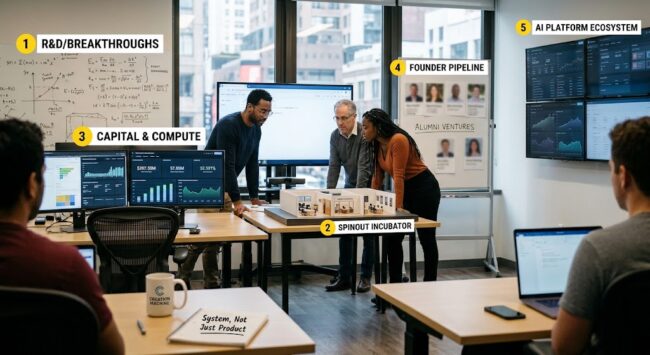
Building one world-changing company is rare. Building 50 requires a system. Five ingredients separate a company-creation machine from a company that simply has good products:
- A source of breakthroughs, such as research labs that produce ideas no one else has.
- A way to turn ideas into companies, through incubators, spinout funds, or venture arms.
- Capital and computing power to back dozens of ventures at once.
- A founder pipeline of employees and alumni who leave to build.
- A platform that other companies can build on, creating whole ecosystems.
The ranking also applies a sixth test: the company must have the financial strength to invest outward. A company fighting to fund its own survival cannot build a portfolio of new businesses.
#1 Alphabet: The Company Factory
Why it ranks first
Alphabet is the only major company that was deliberately restructured to create new companies. When Google reorganized into Alphabet in 2015, the goal was to build new businesses alongside search. In the AI era, that structure has become the strongest company-creation engine in technology.
Companies it has already created
- Waymo, the robotaxi leader, valued at $126 billion in February 2026, giving about 500,000 paid rides a week across 10 U.S. cities, including Miami and Orlando.
- Isomorphic Labs, the Google DeepMind spinout that raised $2.1 billion in May 2026 to design drugs with AI.
- Verily, the AI health company, which raised $300 million in March 2026 and now operates independently with Alphabet as a major shareholder.
- Wing, the drone delivery company, expanding with Walmart to 150 cities.
- Calico, focused on the biology of aging.
- Taara, Chorus, and Anori, recent spinouts from Alphabet’s X lab covering wireless connectivity, AI supply chains, and AI-driven housing development.
The four engines
Google DeepMind produces frontier AI research and the Gemini models. Its science breakthroughs in protein structure, materials, and weather prediction could seed many more Isomorphic-style companies.
X, the moonshot factory, partners with Series X Capital, an independent fund led by former YouTube and Facebook CFO Gideon Yu that gets the first outside look at X projects and invests only in them. X leader Astro Teller expects to graduate about two companies a year.
GV and CapitalG, Alphabet’s venture arms, hold stakes in hundreds of startups at every stage.
The alumni network. According to Dealroom, former Google DeepMind employees have founded 68 venture-backed startups across 10 countries, including 18 unicorns, with a combined enterprise value of more than $1.2 trillion.
The path to 50
Two X graduates a year produce 20 companies over a decade. DeepMind’s science breakthroughs could add several more. GV and CapitalG will back dozens of AI startups. Counting the companies Alphabet builds, spins out, and funds, reaching 50 world-changing AI companies over the next decade is a realistic projection.
Where its 50 could change the world
Transportation, drug discovery, healthcare, connectivity, housing, logistics, and scientific research.
Risks
- Talent loss. Alphabet often trains founders who build competitors.
- Dilution. When projects spin out, Alphabet owns only part of the upside.
- Failures. Some moonshots never succeed, and others, like the robotics company Intrinsic, get folded back into Google.
- Spending. Alphabet expects $180 billion to $190 billion in capital expenditures in 2026.
How investors own it
Through GOOGL or GOOG shares, which include every Other Bet, spinout stake, and venture investment.
#2 Nvidia: The Company Midwife
Why it ranks second
Nvidia does not found companies. It helps bring them into the world, supplies them as they grow, and invests in them as they scale. If Alphabet is the factory, Nvidia is the midwife for the entire industry. It ranks second only because it owns minority stakes rather than building and controlling the companies.
How Nvidia helps create companies
The startup on-ramp. Nvidia Inception gives AI startups free technical training, cloud credits, hardware discounts, marketing support, and investor introductions, with no fees or equity required. Nvidia described the program as having more than 40,000 members as of March 2026. Qualified startups can receive nearly $300,000 in credits and discounts, including up to $100,000 in cloud computing credits.
The capital. According to Dealroom, Nvidia joined 53 venture rounds of $100 million or more between January and August 2026, more than any venture capital firm. Its equity investments were valued at about $99 billion as of its quarter ending July 26, 2026, up from about $7 billion a year earlier. Its venture arm, NVentures, had made about 131 investments according to CB Insights.
The proof. NVentures portfolio companies include Generate Biomedicines, which completed a $400 million Nasdaq IPO in February 2026, and CoreWeave, which went public in 2025. Nvidia also acqui-hired the team at Essential AI in June 2026.
The path to 50
Among Nvidia’s 40,000-plus Inception members and dozens of large portfolio investments, many of the decade’s world-changing AI companies are almost certainly already in its network. Nvidia does not need to create them from scratch. It only needs to help them grow, sell them chips, and own a piece of the winners.
Where its 50 could change the world
Robotics, autonomous vehicles, drug discovery, quantum computing, energy simulation, and AI infrastructure.
Risks
- Minority ownership. Nvidia captures chip revenue and investment gains, not control.
- Competition. Alphabet’s TPUs and Amazon’s Trainium chips give startups alternatives.
- Conflicts. Investing in customers can raise questions about chip allocation.
- Volatility. Nvidia lost about $1 trillion in market value in under two months in mid-2026 before recovering.
How investors own it
Through NVDA shares or semiconductor and broad market index funds.
#3 Amazon: The In-House Builder
Why it ranks third
Amazon has created more giant businesses from within than almost any company in history, and it has the cash flow, cloud infrastructure, and distribution to keep doing it. It ranks third because it builds those businesses inside Amazon rather than as independent companies, which limits how many separate companies it produces.
Businesses it has already built
- Amazon Web Services, which started as an internal tool and now runs at a $169 billion annual pace, growing 36.7% in the second quarter of 2026 with a $496 billion backlog.
- Custom chips, a Trainium and Graviton business with a run rate of more than $25 billion and over $225 billion in Trainium revenue commitments.
- Prime, the Marketplace, Kindle, Alexa, and Amazon Advertising, each a major business built from scratch.
- New ventures in 2026, including Amazon Now’s 30-minute delivery in more than 250 cities, Amazon Supply Chain Services, AWS Continuum for AI-powered security, Amazon Leo satellite internet, and Zoox robotaxis.
How it helps others create companies
AWS Activate, Amazon’s startup program, partners with Nvidia Inception, and Amazon Bedrock lets hundreds of thousands of customers build products on top of leading AI models. Many startups that change the world will run on AWS.
The path to 50
Amazon could realistically create 10 to 15 major AI-driven businesses over the next decade, most of them as Amazon divisions. Its broader contribution to the 50 comes from hosting, powering, and distributing other companies.
Risks
- No spinout structure. Promising ventures stay inside Amazon.
- Model gap. Amazon relies heavily on partners for its most advanced AI models.
- Cash burn. Capital spending of about $220 billion in 2026 turned its trailing free cash flow negative.
How investors own it
Through AMZN shares, which include AWS, its chip business, retail, advertising, and its AI investment stakes.
#4 Microsoft: The Product Multiplier
Why it ranks fourth
Microsoft is extraordinary at turning AI into revenue, with an AI business above a $37 billion annual run rate. But it grows mainly through partnerships, acquisitions, and features inside existing products. It is the company most likely to create 50 world-changing AI products, and less likely to create 50 independent companies.
How Microsoft creates value
- Partnerships. Its early bet on OpenAI turned into a 27% stake and a 20% revenue share through 2032.
- Talent acquisition. It brought in most of the Inflection AI team, including DeepMind co-founder Mustafa Suleyman, to create its Microsoft AI division, which unveiled seven in-house models in 2026.
- Product transformation. Microsoft 365 Copilot has more than 20 million paid seats, GitHub Copilot is reshaping how software is written, and Microsoft reported 420 million monthly active Copilot users in early 2026.
- Startup support. Microsoft runs a startup program that partners with Nvidia Inception, and its venture arm invests in AI startups.
The path to 50
Microsoft’s breakthroughs will mostly appear as transformed products inside Office, Azure, GitHub, Dynamics, and security. Its contribution to 50 world-changing companies comes mainly through its investment stakes and the startups that run on Azure.
Risks
- Low Copilot penetration. Paid Copilot seats cover only about 4.4% of its commercial base.
- Spending. About $190 billion in capital expenditures is expected in 2026.
- A looser OpenAI relationship. OpenAI ended its exclusive commitment to Azure in April 2026.
How investors own it
Through MSFT shares, which include Azure, Microsoft 365, GitHub, LinkedIn, and the OpenAI stake.
#5 Meta: The Open-Source Seeder
Why it ranks fifth
Meta has a company-creation channel no one else on this list has: open-source AI. By releasing its Llama models for anyone to use, Meta gave thousands of startups a free foundation to build on. It also has the cash flow to invest outward, and it is doing so. It ranks fifth because most of its own AI work still flows back into its advertising business.
How Meta helps create companies
Open-source Llama. Startups around the world have built products on Llama without paying licensing fees, making Meta one of the largest indirect seeders of AI companies.
The alumni network. Two of Mistral AI’s three co-founders, Guillaume Lample and Timothée Lacroix, were Meta researchers who helped build Llama. Mistral was valued at about $14 billion in September 2025.
Big outward deals. In June 2025, Meta invested about $14.3 billion for a 49% stake in Scale AI, valuing the data company at more than $29 billion. In December 2025, it agreed to acquire Manus, an AI agent startup that had passed $100 million in annual recurring revenue, in a deal reported at more than $2 billion.
The financial engine. Meta’s AI-powered advertising product, Advantage+, reached a $60 billion annual run rate in the third quarter of 2025. Zuckerberg has said Meta plans to invest $600 billion in U.S. AI technology and infrastructure by 2028.
The path to 50
Meta’s path runs through its platform and its alumni. Every major Llama release gives new startups a foundation to build on, and Meta’s researchers will keep leaving to found companies. Meta is unlikely to own most of them, but it will help create many.
Risks
- Ad gravity. Most of Meta’s internal AI work ends up improving advertising rather than becoming new companies.
- Execution. Meta rebuilt its AI program in 2025 after a disappointing Llama 4 launch.
- Spending. Capital expenditure guidance of $125 billion to $145 billion in 2026.
- Partner fallout. OpenAI and Google ended work with Scale AI after Meta’s investment.
How investors own it
Through META shares, which include its apps, advertising business, AI labs, and its Scale AI stake.
The Wild Card: Palantir, the Founder Factory
Why it earns a spot
Every company above creates businesses through labs, money, or platforms. Palantir has a different and unusual skill: it manufactures founders. No company of its size has produced more successful entrepreneurs, and the reason is the way it trains its people.
The unique skill: forward-deployed engineering
Palantir sends its engineers directly into customer operations, from defense agencies to oil companies to hospitals, to build working systems on site. That model, known as forward-deployed engineering, teaches engineers to solve messy real-world problems, work directly with customers, and deliver under pressure. Those are exactly the skills founders need.
Palantir’s business shows the model works. In the second quarter of 2026, revenue grew 93% to $1.94 billion, U.S. commercial revenue grew 149% to $764 million, and adjusted free cash flow margin reached 63%. It raised full-year 2026 revenue guidance to more than $8.15 billion, implying about 82% growth. Management described a head-to-head deployment in which its AI platform and engineers beat a frontier AI lab’s own team.
The founders it has produced
According to Dealroom, Palantir alumni have founded 48 documented startups across five countries, including 17 unicorns, with a combined enterprise value of about $152 billion. A broader dataset compiled by Business Insider identified more than 335 former Palantir employees who became founders. The best-known include:
- Anduril, the defense technology company, valued at about $61 billion according to Dealroom.
- Kalshi, the prediction market, valued at about $22 billion.
- Ironclad, the AI legal contracting platform.
- Hex, the data analytics platform.
- Chapter, the Medicare guidance company.
Garry Tan, the president and CEO of Y Combinator, is also a former Palantir engineer, meaning a Palantir alum now runs the world’s most prolific startup accelerator.
The emerging ecosystem
Palantir alumni are now building companies designed to plug back into Palantir’s platform. Valinor Enterprises, an incubator co-founded in 2024 by Anduril co-founder Trae Stephens and former Palantir senior vice president Julie Bush, launched what it described as the first third-party application installable in Palantir’s Foundry platform. Other alumni firms provide forward-deployed engineering for Palantir customers. If that trend grows, Palantir could become a platform that spawns an ecosystem of companies, much as Salesforce and Microsoft did in earlier eras.
Why it is a wild card, not a top-five pick
Palantir does not spin out or own the companies its alumni build. Most of its founder output creates value for those founders and their investors, not directly for Palantir shareholders. It joins the top tier if its platform becomes the foundation that alumni companies are built on.
How investors own it
Through PLTR shares. Investors seeking exposure to its alumni companies would need private funds or future IPOs.
Why OpenAI Did Not Make the List
OpenAI built the most famous AI product in history, but it is not positioned to create a portfolio of new companies. The Information reported that its internal forecast projects a loss of about $14 billion for 2026, and it is raising tens of billions of dollars mainly to fund its own computing needs. Its valuation target was trimmed after investor pushback, and its CEO has ruled out a 2026 IPO. Its largest recent deal, the roughly $6.5 billion acquisition of Jony Ive’s device startup io, was about feeding its own product line, not building independent companies. Many successful companies have been founded by people who left OpenAI, but those are not OpenAI creations, and several compete with it directly.
Honorable Mention: Y Combinator
Y Combinator is not a tech giant, but it may launch more AI companies than anyone. Its Winter 2026 batch of 199 companies saw 14 reach $1 million in annual recurring revenue before Demo Day, more than triple the historical rate. Many of its startups build on Nvidia chips, run on Amazon, Microsoft, or Google clouds, and use open-source models like Llama.
What Would Change the Rankings
- Nvidia moves to first if it begins incubating companies directly.
- Amazon moves up if it creates a spinout structure for internal ventures.
- Microsoft moves up if it launches independent AI companies rather than features.
- Meta moves up if its superintelligence lab produces standalone businesses beyond advertising.
- Palantir enters the top five if its platform becomes the foundation for a large ecosystem of alumni companies.
- Alphabet slips if it keeps losing top researchers faster than it can spin out companies.
Brian’s Take
When I managed money, the companies I valued most were not the ones with the best single product. They were the ones that kept producing new businesses year after year. A great product eventually matures. A great company-creation machine compounds.
Alphabet is that machine in the AI era. It has the research labs, the moonshot factory, the spinout fund, and the venture arms, and Waymo alone shows what it can do. Nvidia is the midwife present at the birth of more AI companies than anyone else. Amazon, Microsoft, and Meta each bring a different kind of strength: in-house building, product scale, and open-source reach.
What excites me most is Palantir. Its forward-deployed engineers learn to solve the hardest real-world problems, then leave to build companies like Anduril. That is a talent engine as valuable as any research lab.
Put these engines together and you get the quickening at its most powerful: more founders, more companies, and more solutions to the world’s hardest problems, arriving faster than ever before.
FAQ
Which company can create 50 world-changing AI companies?
Alphabet, because it builds companies through Google DeepMind and X, spins them out through Series X Capital, invests through GV and CapitalG, and has the largest network of AI founder alumni.
Why isn’t Nvidia ranked first?
Nvidia helps more AI startups start and grow than anyone, but it funds and supplies them rather than founding and owning them.
Why is Meta in the top five?
Its open-source Llama models give thousands of startups a free foundation, its alumni co-founded Mistral AI, and it has made large outward investments such as its $14.3 billion stake in Scale AI.
What makes Palantir a wild card?
Its forward-deployed engineering model trains employees to become founders. Its alumni have founded 48 documented startups worth about $152 billion combined, including Anduril and Kalshi.
Why isn’t OpenAI on the list?
OpenAI is focused on funding its own growth, with a projected loss of about $14 billion in 2026, rather than building a portfolio of new companies.
Where does Florida fit in?
Waymo, an Alphabet company, already operates paid robotaxi service in Miami and Orlando, and Florida startups can join Nvidia Inception and the startup programs run by Amazon and Microsoft.
Sources and Further Reading
- Dealroom — The Google DeepMind Mafia
- X, The Moonshot Factory — Bringing Moonshots to Market (August 2026)
- TechCrunch — Alphabet’s X has a new spinout (March 2026)
- SiliconANGLE — Verily steps out from under Alphabet’s shadow after raising $300M
- AI2Work — Waymo Hits Half a Million Weekly Rides
- Life Science Daily News — Isomorphic Labs $2.1 billion Series B
- Causo — How to Apply to NVIDIA Inception in 2026
- Dealroom — Nvidia as a megaround investor (September 2026)
- CB Insights — NVentures investor profile
- Global Venturing — Powerlist 2026: NVentures
- Amazon — Second Quarter 2026 Results
- About Amazon — How Amazon became one of the world’s top chip companies
- GeekWire — Microsoft’s accelerating Azure growth and $37B AI run rate
- Empowering.Cloud — 20M M365 Copilot seats and the OpenAI deal reset
- Seeking Alpha — Meta invests $14.3 billion in Scale AI
- Nairametrics — Meta acquires AI startup Manus
- Boerse Express — Meta’s Manus deal and Advantage+ run rate
- Fast Company — Meta just bought one of the fastest-growing AI startups
- AI Wiki — Mistral AI company profile
- Dealroom — The Palantir Mafia
- Yahoo Finance (Business Insider) — 9 startups from Palantir alumni you need to know
- Wikipedia — Trae Stephens and Valinor Enterprises
- Palantir — Q2 2026 earnings release (SEC Form 8-K)
- Futurum Group — Palantir Q2 FY 2026 Earnings Surge on US Commercial AI Demand
- Algeria Tech — YC W26 Demo Day: 14 startups hit $1M ARR
This article is for informational purposes only and is not investment advice. Investors should consult a licensed financial advisor before making investment decisions.
About Brian French
Led by a commitment to tech-intelligent curation, Brian French tracks and analyzes the Florida Business News defining Florida's economy. Brian brings an extensive financial background to his analysis, having graduated from the University of South Florida in Finance and serving as a Vice President and Portfolio Manager for Merrill Lynch Private Investors and the Trust Department in St. Petersburg, FL, as well as a Vice President and Trust Investment Officer for SunTrust Bank in Sarasota, FL. His writing blends macroeconomic trends, capital markets, corporate strategy, and modern digital insights for a sophisticated look at Florida's business market.