FloridaBusinessNews.net | By Brian French. Brian French is founder and publisher of the Florida Authority Network and a Florida business news analyst with more than 20 years of experience as an analyst and money manager.
Quick Answer: Most Florida businesses are not wealthy employers. About 86% have no employees at all, and the typical U.S. one-person business brings in roughly $59,000 a year in gross receipts before expenses. For these owners, a first employee costing $40,000 or more is out of reach, while AI tools can take on marketing, customer service and bookkeeping tasks for a small monthly fee. For most of Florida’s small businesses, the next “hire” will be software.
The Myth of the Wealthy Employer
Picture the typical American business. For many people, the image that comes to mind is a corporate campus, a glass tower or a household brand with thousands of workers and billions in profit.
That picture shapes public debate. When people argue that “business” should pay workers more, cover more benefits or shoulder more costs, they usually imagine a company that can easily afford it. The underlying assumption is simple: businesses are rich, so they can do more for employees.
The data tells a very different story. The typical business in Florida is not a corporation at all. It is one person, often working from home or a truck, with no payroll, no HR department and no guarantee of a steady income. Many of these owners are not building fortunes. They are paying their own bills.
Understanding who really owns Florida’s businesses changes the conversation about wages, mandates and hiring. It also explains why the next wave of business growth in Florida is likely to come from artificial intelligence rather than new employees.
What Florida’s Business Count Actually Looks Like
The U.S. Census Bureau tracks two kinds of businesses: employer firms, which have at least one paid worker, and nonemployer businesses, which have no payroll and are typically run by the owner alone.
In Florida, the gap between the two is enormous. The state had 3,117,327 nonemployer establishments in 2023, compared with 500,294 employer firms.
| Florida Businesses, 2023 | Count | Approximate Share |
|---|---|---|
| Businesses with no employees | 3,117,327 | About 86% |
| Businesses with at least one employee | 500,294 | About 14% |
| Total | About 3.6 million | 100% |
Share calculated by FloridaBusinessNews.net from Census figures. Nonemployer data counts establishments and employer data counts firms, so the percentages are approximate.
Put plainly, roughly six out of every seven businesses in Florida are a single owner with no staff.
Florida stands out nationally on this measure. In 2022, the state had the highest concentration of one-person businesses in the country, with 13.3 nonemployer establishments for every 100 residents. Wyoming and Georgia were a distant second at 10.8.
Florida’s solo business base is also growing fast. Between 2022 and 2023, Florida posted one of the three largest percentage gains in the country, at 5.0%, alongside Delaware and Wyoming.
Nationally, the pattern is the same. In 2023, the U.S. had 30.4 million nonemployer businesses with $1.8 trillion in receipts, out of 36.4 million total businesses. And for more than a decade, these solo operations have multiplied faster than businesses with staff. From 2012 to 2023, nonemployers grew an average of 2.7% a year, compared with 1.1% for employers.
The direction is clear. More Americans, and especially more Floridians, are choosing to run businesses without hiring anyone.
Where America’s Workers Actually Work
If most businesses have no employees, where do most workers go every day? The answer is the opposite of the popular image of small business as the engine of American employment.
Employment is heavily concentrated in a relatively small number of very large companies. Using Census business data, one analysis found that about 30% of private-sector workers are employed by just 1,112 firms with more than 10,000 employees. Meanwhile, the nearly 4.8 million businesses with fewer than 10 employees account for less than 10% of private employment.
Bureau of Labor Statistics data points the same way. In 2024, firms with more than 250 employees accounted for almost 56% of private-sector employment, a share that has grown considerably since 2004.
| Who Employs America’s Private Workforce | Share of Workers |
|---|---|
| About 1,100 firms with 10,000+ employees | About 30% |
| Firms with 250+ employees | About 56% |
| Nearly 4.8 million firms with fewer than 10 employees | Less than 10% |
So there are two very different business worlds. One is a small group of large, often highly profitable companies that employ most workers. The other is millions of tiny businesses, most with no workers at all.
Public policy frequently treats them as if they were the same.
Most Owners Are Getting By, Not Getting Rich
The term “business owner” suggests wealth. For most solo operators, the reality is more modest.
Divide the $1.8 trillion in nonemployer receipts by the 30.4 million businesses that earned it, and the average comes to roughly $59,000 per business. That is gross receipts, not profit. Before the owner takes home a dollar, that money has to cover supplies, fuel, insurance, software, licenses, equipment and taxes, including self-employment tax.
For perspective, consider what it would cost that average solo business to add one Florida employee at the state’s new $15 minimum wage, which took effect Sept. 30, 2026.
| The First-Employee Gap | Annual Amount |
|---|---|
| Average gross receipts of a U.S. nonemployer business | About $59,000 |
| Wages for one full-time $15-an-hour worker (2,080 hours) | $31,200 |
| Employer payroll and unemployment taxes | About $2,600 |
| Benefits at the Southern average share of compensation | About $9,800 |
| Total cost of first employee | About $43,600 |
| Share of average solo business receipts | About 74% |
FloridaBusinessNews.net estimates. Benefits based on the South’s 28.4% benefit share of total compensation. Average receipts calculated from Census totals.
Read that bottom line again. For the average solo business, hiring one minimum-wage worker would consume about three-quarters of everything the business brings in, before rent, supplies or the owner’s own pay. Unless that worker immediately generates large amounts of new revenue, the owner cannot afford them.
Collectively, all of these one-person businesses produced about 6.4% of U.S. GDP in 2023. They matter. But individually, most are small, fragile and far from rich.
Loved in Polls, Treated Like Big Business in Policy
Here is the paradox. Americans overwhelmingly trust small business, and overwhelmingly distrust big business.
In June 2025, just 15% of Americans said they had a great deal or quite a lot of confidence in big business, compared with 70% for small business. In a separate 2025 poll, 95% viewed small business positively, versus 37% for big business. In Gallup’s 2026 survey, small business was the only institution of 17 measured to earn majority confidence.
Yet when lawmakers write rules about wages, benefits, leave or liability, they rarely draw sharp lines between a 30,000-person corporation and a three-person family business. The rhetoric often targets giant, highly profitable companies. The costs land on everyone, including the Florida landscaper, the home health aide who wants to add a helper and the solo bookkeeper thinking about a part-time assistant.
When national figures accuse employers of paying “starvation wages,” as Sen. Bernie Sanders did at Walmart’s 2019 shareholder meeting, the target is a corporate giant. But the small business owner hears the same message: employers are the problem.
The result is a public that loves small business in principle, and a policy environment that often makes it harder for small businesses to grow by adding people.
Why the First Employee Is the Hardest
For a business going from zero employees to one, the jump is not just financial. It is structural.
The moment a Florida owner hires, they must register for reemployment tax, carry workers’ compensation where required and report the new hire to the state within 20 days. They inherit legal responsibility for what that worker does on the job. They become a trainer, a scheduler, a supervisor and a compliance officer, often without any experience doing those things.
And the payoff is slow. Gallup estimates most new workers need more than a year to reach full proficiency, while BLS data shows workers ages 25 to 34 stay with an employer for a median of only 3.0 years.
For a business grossing $59,000, that is not a growth plan. It is a gamble with the household budget.
Why AI Is the Logical Next Hire
That is where artificial intelligence enters the picture. For the first time, a one-person business can add meaningful capacity without adding a person.
AI tools now draft marketing emails and social posts, answer customer inquiries around the clock, organize receipts and invoices, summarize documents, research competitors and help schedule appointments. A newer category, AI agents, can carry out a series of steps on their own, such as handling a routine customer request from start to finish.
For most Florida businesses, AI makes sense as the next hire for several practical reasons:
- It fits the budget. Many AI tools cost a monthly subscription rather than a salary, a fraction of the $43,600 annual cost of a first employee.
- There is no ramp-up period. AI tools are useful on day one, while a human hire may take months to become productive.
- It works around the clock. An AI assistant can respond to a customer at 11 p.m. on a Sunday without overtime.
- It doesn’t trigger employment thresholds. Subscribing to software doesn’t require reemployment tax registration, workers’ comp coverage or new-hire reporting.
- It scales up and down instantly. A busy season doesn’t require hiring, and a slow season doesn’t require layoffs.
- It reduces legal exposure. Software won’t file a discrimination claim, cause a car accident on the clock or walk off with the client list.
The Adoption Curve Is Bending Upward
Businesses are already moving in this direction. According to the Census Bureau’s survey of employer businesses, 23.8% reported using AI in late summer 2026, up from 17.7% at the start of the year.
Small business surveys show even broader use. Thryv found 66% of small businesses using AI in July 2026, up from 55% a year earlier, and the Small Business & Entrepreneurship Council found 82% of small business employers had adopted at least one AI tool.
The most revealing number: 46% of small business owners say they would choose AI over hiring a new employee for the same task. AI users also report substantial time savings, with about four in five saving 11 to 60 hours a month.
The Jobs AI Fills First
AI is moving fastest into the jobs small business owners already do themselves. In a 2026 survey, owners said they regularly act as their own customer service rep (54%), marketer (44%) and bookkeeper (43%).
Those same three functions top the list of AI uses. Among U.S. small and midsize businesses using AI, 45% apply it to marketing, 37% to customer service and 35% to bookkeeping.
| Role a Solo Owner Fills | How AI Can Help |
|---|---|
| Marketer | Writes posts, emails, ads and website copy |
| Customer service rep | Answers routine questions and messages 24/7 |
| Bookkeeper | Sorts transactions and flags errors |
| Receptionist | Handles calls, chats and appointment booking |
| Researcher | Gathers data and summarizes information |
FloridaBusinessNews.net summary. Capabilities vary by tool.
Florida’s Huge Runway
Florida is especially well positioned for this shift. It has more solo businesses per capita than any other state, and those are exactly the businesses with the most to gain.
Yet many of them haven’t started. Census data shows fewer than 20% of firms with four or fewer employees reported using AI, and use among firms with fewer than 20 employees didn’t change significantly between December 2025 and May 2026. That leaves millions of Florida owners who could add capacity through AI before ever considering a human hire.
A Florida Example
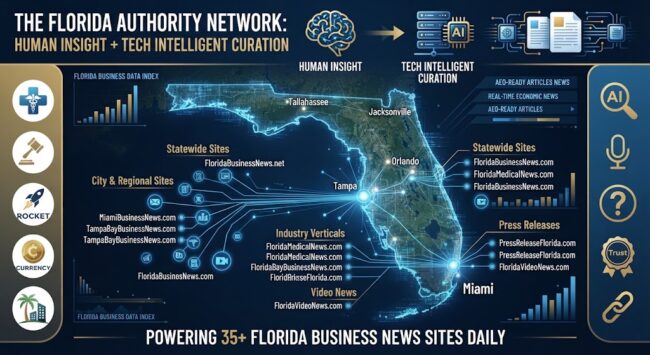
The Florida Authority Network, which publishes FloridaBusinessNews.net, is built on this approach. A single owner operates more than 35 Florida news, industry, video and press release sites with more than 2,500 published articles.
A generation ago, that output would have required a newsroom. Today, AI tools help gather public information, organize research and structure content, while a human analyst verifies the facts and makes the editorial judgments. It is a practical model of how one person, supported by AI, can do work that once required a staff.
Being Realistic About the Limits
AI does not replace everything a good employee can do. Census research found that among firms using AI to take over tasks, 71% do so for only a small number of them. Most owners see it as a helper: in one survey, only 8% said AI primarily replaces workers, while 52% said it complements them. And AI makes mistakes that a person must catch.
But for a business with no employees, the comparison is not AI versus a great team. It is AI versus doing everything alone, or AI versus a $43,600 commitment the business can’t afford. In that comparison, AI wins for most Florida owners.
What Lawmakers and the Public Should Understand
The debate over what businesses “owe” workers would look very different if it started with the real numbers.
Most businesses are not employers. About 86% of Florida businesses have no staff. Policies aimed at “business” mostly affect owners who are trying to decide whether they can afford their first worker.
Most owners are not rich. The average solo business brings in about $59,000 in gross receipts. Treating every business owner like a corporate executive misreads the economy.
Big companies employ most workers. Debates about pay at the largest corporations are legitimate, but rules written with them in mind fall hardest on the smallest firms.
AI is now the alternative. Each new cost added to a human hire makes software more attractive. The first-employee decision is increasingly a choice between a person and a subscription.
Small business can still create jobs. Policies that lower the cost and risk of the first hire, such as simpler compliance for very small employers, would give Florida’s millions of solo owners a real reason to add a person instead of a program.
Frequently Asked Questions
What percentage of Florida businesses have no employees?
About 86%. Florida had about 3.1 million nonemployer businesses and about 500,000 employer firms in 2023, according to Census data.
Do most American workers work for small businesses?
No. About 56% of private-sector workers are employed by firms with more than 250 employees, and roughly 30% work for about 1,100 companies with more than 10,000 employees. Businesses with fewer than 10 employees account for less than 10% of private employment.
How much does a typical one-person business earn?
The average U.S. nonemployer business brings in about $59,000 a year in gross receipts, before expenses and taxes.
Which state has the most one-person businesses per capita?
Florida. The state had 13.3 nonemployer businesses for every 100 residents in 2022, the highest rate in the nation.
Why will AI be the next hire for many Florida businesses?
AI tools cost far less than an employee, are productive immediately, work around the clock and don’t trigger payroll, workers’ comp or new-hire requirements. Nearly half of small business owners say they would choose AI over a new hire for the same task.
Do Americans trust small businesses more than big businesses?
Yes. In 2025, 70% of Americans expressed confidence in small business, compared with 15% for big business.
Sources and Further Reading
- QuickFacts: Florida, U.S. Census Bureau
- Census Bureau Statistics Shed Light on Self-Employment by Sector and State, U.S. Census Bureau
- Number of U.S. Nonemployers Grew Faster Than Employer Businesses Nearly Every Year From 2012 to 2023, U.S. Census Bureau
- Census Bureau Releases New Data About Characteristics of Employer and Nonemployer Business Owners, U.S. Census Bureau
- How Many Businesses Are There in America, Certified Employee-Owned, citing Census Statistics of U.S. Businesses
- Distribution of Private-Sector Employment by Firm Size, Statista, citing U.S. Bureau of Labor Statistics
- Americans Dislike Big Business, Gallup
- Confidence in U.S. Institutions Mired Near Record Low, Ground News, citing Gallup
- Florida’s Minimum Wage Reaches $15.00 on September 30, 2026, Lowndes
- Employer Costs for Employee Compensation for the Regions, March 2026, U.S. Bureau of Labor Statistics
- How to Hire a Worker in Florida, Deel
- Remote Employee Onboarding Time-to-Productivity Statistics 2026, Stealth Agents, citing Gallup
- Employee Tenure in 2026, U.S. Bureau of Labor Statistics
- Bernie Sanders Urges Walmart to Boost “Starvation Wages,” Reuters via BusinessWorld
- U.S. Business AI Use by State and Industry, Start Business by State, citing Census Business Trends and Outlook Survey
- Large Firms With at Least 20 Employees Biggest AI Users, U.S. Census Bureau
- Measuring AI Use in the U.S. Economy, Census Bureau AI Supplement, via National Academies
- Small Businesses Are Using AI to Grow Without Hiring, Startup Fortune, citing SBE Council and Thryv
- Small Business AI Adoption Surges but Training Gaps Persist, BriefGlance, citing Thryv
- 77% of Small Businesses Now Use AI Regularly, Stacker
- Small Business Owners and AI Survey, Business2Community, citing Adobe Express and Talker Research
About Brian French
Led by a commitment to tech-intelligent curation, Brian French tracks and analyzes the Florida Business News defining Florida's economy. Brian brings an extensive financial background to his analysis, having graduated from the University of South Florida in Finance and serving as a Vice President and Portfolio Manager for Merrill Lynch Private Investors and the Trust Department in St. Petersburg, FL, as well as a Vice President and Trust Investment Officer for SunTrust Bank in Sarasota, FL. His writing blends macroeconomic trends, capital markets, corporate strategy, and modern digital insights for a sophisticated look at Florida's business market.