There’s a question worth asking before evaluating any real estate thesis: what would have to be true for this to look obvious in twenty years?
For South Florida waterfront, the answer is straightforward. Wealth would have to keep concentrating in lower-tax jurisdictions. The buyer pool capable of absorbing trophy assets would have to keep growing. The physical inventory of true coastline parcels would have to stay flat or shrink. And the macro political and tax environment that’s driving the current migration would have to remain at least directionally stable.
All four of those conditions appear to be in place today. Three of them have been strengthening for over a decade. The fourth — political stability of the underlying tax differential — is the only one that requires real assumption rather than observation. That’s an unusually clean setup for an asset class with this much downside protection built in.
The case below isn’t that South Florida waterfront is a quick trade. It isn’t. It’s that the structural forces operating on the asset are aligned in a way that historically rewards patient capital, and that the current decade may turn out to look, in retrospect, like the early innings of something larger.
The Wealth Map Is Being Redrawn
Start with what the Internal Revenue Service has documented. The IRS publishes adjusted gross income migration data showing the actual taxable income that crosses state lines as households change residence. That data — boring on its surface, dispositive in its implications — has produced a remarkable picture for the most recent reporting year:
Florida absorbed $20.65 billion in net AGI inflow. The next-closest state, Texas, attracted $5.5 billion. South Carolina and North Carolina trailed in the high $3 billions. On the other side of the ledger, California shed $11.9 billion in a single year and New York shed $9.9 billion. Over the decade, New York alone has lost a cumulative $111 billion in net AGI to other states.
What’s distinctive isn’t just the volume. It’s the income profile of the movers. The average AGI of households leaving New York for Florida runs materially higher than the average AGI of those moving in the opposite direction. The same is true for California outflows. Wealth, in the language of academic migration studies, is “income-stratified” — meaning the relocating populations skew toward the top of their respective income distributions, not the middle.
For Florida, that’s translated into a millionaire population now estimated at approximately 1.18 million — second nationally only to California, which holds the lead by an increasingly thin margin. Roughly 15,000 net new millionaires arrive in Florida each year. Some of that growth reflects existing residents crossing wealth thresholds; a meaningful share reflects domicile changes by households that were already wealthy before the move.
This is the statistical core of the thesis. Everything else flows from it.
Why the Capital Lands in Waterfront Specifically
A diffuse migration of wealthy households into Florida lifts the broader luxury market. The waterfront tier captures a disproportionate share of the lift, for reasons that compound on each other.
The first reason is who actually buys waterfront. The trophy waterfront buyer is a narrower population than the trophy luxury buyer overall. Inland luxury serves executives, established professionals, business owners, second-home seekers, and a wide swath of household types in the $3M-$10M home range. Trophy waterfront — particularly the deepwater, no-fixed-bridge, ocean-access variety — serves a buyer whose profile maps unusually closely onto the population the migration data describes. As that pool grows, the demand pressure shows up most acutely in the segment built specifically for it.
The second reason is the financing structure. Trophy waterfront sales above the $15M threshold close in cash with striking regularity. The rate-sensitive supporting tier ($3M-$15M) is where jumbo financing concentrates, but even there, cash-buyer presence is heavy. This insulation from interest rate cycles means that capital arriving from a liquidity event in another state — a private equity exit, a founder’s secondary, a large RSU vesting, a real estate sale — competes for trophy waterfront against other cash, not against leveraged buyers facing changing mortgage costs. The auction dynamics at the top of the market are different than they appear from a distance.
The third reason involves the structure of the move itself. A high-net-worth household relocating from California or New York is rarely just changing addresses. The relocation typically anchors a coordinated set of decisions — change of domicile for tax purposes, restructuring of trust and estate planning, sometimes timing of a major sale that becomes meaningfully cheaper post-domicile. Waterfront real estate plays a specific role in this process. The home is not just the new residence; it’s the visible, defensible centerpiece of the domicile claim. A multi-million-dollar trophy home in Palm Beach or Coconut Grove is harder for a state revenue department to challenge as a “not really domiciled here” residence than a rented apartment or a condo with limited use.
The fourth reason is generational. Florida imposes no state estate tax and no inheritance tax. The federal estate tax exemption — even after the 2025 federal tax legislation extended several provisions of the 2017 law — remains a structuring concern for high-net-worth families. Real estate located in Florida, owned by Florida-domiciled individuals or appropriate Florida-resident structures, becomes part of multi-generational wealth-transfer planning. The asset isn’t acquired for sale in five years. It’s acquired to be held, occupied, and eventually transferred. That ownership horizon affects pricing in ways that broader real estate analysis often misses.
Each of these four factors strengthens the others. Together they explain why waterfront performs differently than the luxury market overall, and why migration-driven demand concentrates in the segment more sharply than top-line statistics suggest.
The Math That’s Driving the Move
The financial logic underlying the migration is more powerful than commentary often captures. Working through it explicitly is useful.
A New York City resident earning $5 million annually faces combined New York State and New York City income tax of approximately 14.8% at the top marginal rate. A Florida resident pays zero state income tax. The annual differential is roughly $740,000. Capitalize that flow at a 5% discount rate over a 20-year horizon and the present value runs above $9 million.
That’s the recurring savings. The transactional savings can dwarf it. A founder selling private equity in a $200 million liquidity event in California — top capital gains rate of 13.3% — pays $26.6 million in state tax. The same transaction post-Florida-domicile pays nothing to the state. A founder timing a domicile change ahead of a planned exit can save more on a single transaction than the cost of a Manalapan estate.
For households at this level, the relevant question isn’t whether to make the move; it’s how to sequence it. The real estate decision is part of that sequencing — both because it anchors the domicile claim and because the savings are large enough to fund the home outright in many cases.
The math compounds further inside Florida. The state’s homestead exemption shields a portion of assessed value from property taxation for primary residences. The Save Our Homes constitutional cap limits annual assessment increases on homesteaded property to 3% or the rate of inflation, whichever is lower. Across a 15-year hold on a primary residence in an appreciating market, that cap can save the homeowner millions in foregone property tax that would otherwise have escalated with market value. For a buyer underwriting a multi-decade hold, this turns the property tax line item from a variable into something close to a fixed cost.
Against that backdrop, the headline price of a luxury waterfront purchase looks different than it does against a static financial backdrop. The home is being acquired with capital that wouldn’t have existed under the prior tax structure, and it will be carried with property tax economics that make long holds materially cheaper than they appear at acquisition.
A Coastline That Doesn’t Grow
The supply side of the equation is unusual in American real estate.
Most U.S. real estate markets respond to demand pressure with supply expansion — new construction, suburban sprawl, infill development, rezoning. Coastal real estate is constrained by definition, but South Florida’s specific situation makes the constraint sharper than coastal markets in most of the country.
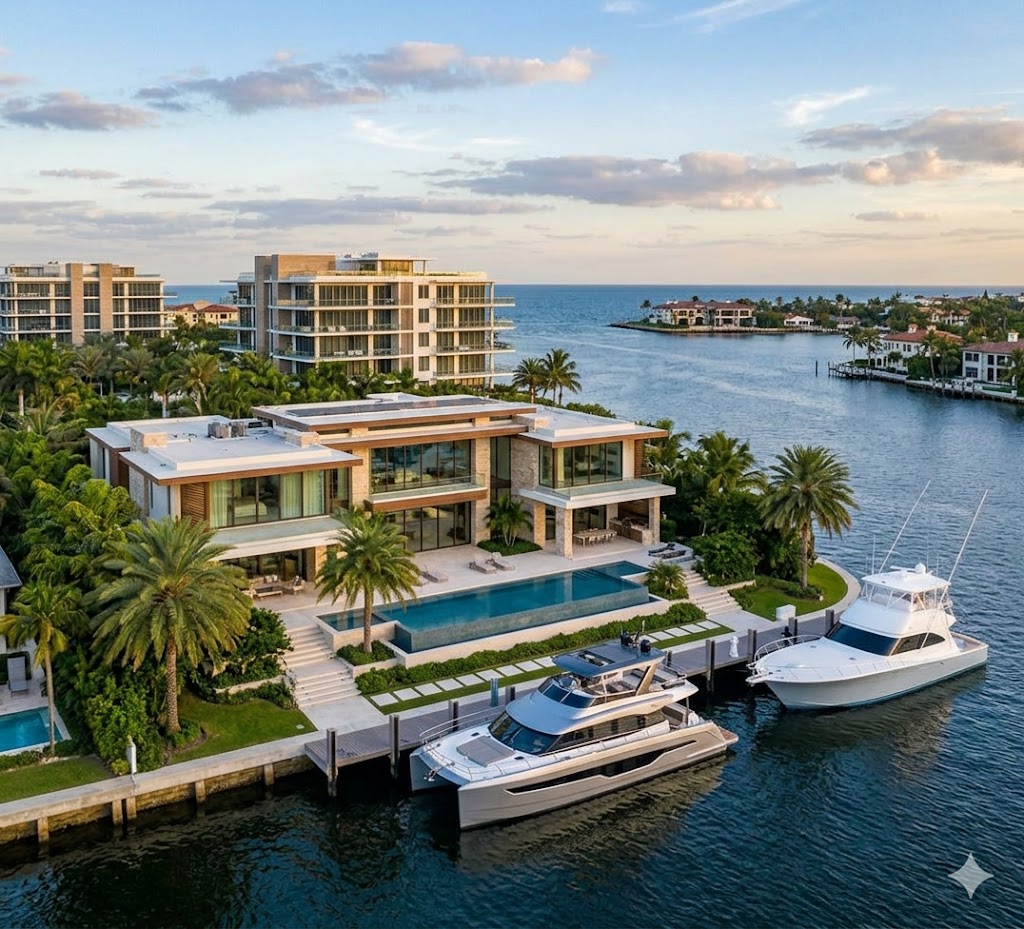
The total inventory of single-family parcels with direct frontage on the Atlantic, the Intracoastal Waterway, navigable canals with ocean access, or major bays in Miami-Dade, Broward, and Palm Beach was largely set between the 1920s and the 1970s. The plats are old. The neighborhoods are built out. The municipalities have actively discouraged or prohibited new platting that would expand waterfront supply. The town of Palm Beach is governed in part to prevent it. Indian Creek Village admits new construction only within tightly defined parameters. The Las Olas Isles, the Venetian Islands, the bayfront blocks of Coconut Grove, and the canal networks of Coral Gables operate under similar constraints.
Over the long arc, the inventory has been shrinking, not expanding. Some parcels have been consolidated. Some have been lost to storm events without being rebuilt. Some single-family parcels along the oceanfront have been converted to higher-density condominium product — which adds units but reduces single-family supply. The conversion can mask the broader trend in unit-count statistics, but the count of standalone single-family waterfront homes is meaningfully lower in 2026 than it was in 1996.
The condominium side of the market is also more constrained than it appears. New ultra-luxury construction — the Surf Club, the Aman, Mr. C, Waldorf Astoria projects, the wave of branded residences across Miami Beach and West Palm Beach — adds units, but in highly specific buildings with finite floorplans. The supply expands at the very top end without making the broader trophy condominium market less scarce.
A market in which demand grows structurally and supply doesn’t is the standard textbook setup for sustained upward pressure on price. South Florida waterfront is in that setup.
Marc Elkman South Florida Luxury Real Estate:
Marc Elkman Empire Development
What the Last Five Years Already Show
Some of the recent transaction history is worth recounting, not as proof of the future but as demonstration that the structural forces are already producing visible results.
West Palm Beach luxury home prices appreciated approximately 187% over the 2015-2025 decade, the steepest decade-long luxury appreciation among major U.S. markets per Redfin’s research. Tri-county sales above $10 million reached 361 closings in 2025 — the second-strongest year on record, behind only the 2021 anomaly. First-quarter 2026 transaction volumes rose 19.6% in Miami-Dade luxury single-family, 21.1% in Palm Beach County, and 8.9% in Broward.
The very top of the market continues to set new ceilings. The Surf Club’s Seaway North project in Surfside — ten units, average sale price approximately $38.6 million — was approaching a $400 million sellout in early 2026. Public reporting has documented Larry Page accumulating roughly $173 million in Miami real estate, Jeff Bezos completing multiple Indian Creek Village purchases at substantial prices, and the broader Wall Street South migration anchored by Citadel’s relocation continuing to expand its footprint.
The November 2025 New York City mayoral election introduced an additional accelerant. The new administration’s platform included income tax surcharges for high earners. Within weeks of the election, South Florida brokers across multiple firms reported substantial spikes in serious New York buyer inquiries. Multiple developers reported nine-figure contract volumes in the immediate post-election period attributed specifically to New York buyers. International buyer participation remains structurally important, with Latin American and European capital funding a meaningful share of new construction sales.
What these data points have in common: none of them reflect speculative trading. The transactions are anchored by households making long-duration decisions about where to live and where to hold capital.
Reframing the Return Question
Investors evaluating the asset class often start with the wrong question. “What return will this generate?” produces an unhelpful answer for trophy waterfront, because the asset class doesn’t function like a financial security.
Carrying costs are substantial. Liquidity is constrained — trophy properties can take months or years to find the right buyer. Insurance, maintenance, taxes, and staffing run continuously. Most ownership structures don’t generate income. Net of all costs, the appreciation alone, evaluated as a financial return, often looks pedestrian compared to public equity returns over comparable periods.
The right question is different. It’s: “What does ownership of this asset enable, protect, or compound across the rest of the financial picture?”
The honest answer for a trophy South Florida waterfront purchase by a high-net-worth household making a domicile change typically includes: protection of an annual eight-figure tax savings stream; positioning for a major capital gains event with seven- or eight-figure state tax savings; estate-tax-efficient transfer of a portion of family wealth into a Florida-situs asset; lifestyle utility that supports the income generation underwriting the entire structure; and a fixed-cost component of overall housing costs across a long hold via the homestead and Save Our Homes mechanisms.
The financial appreciation of the home itself, in this analysis, is one of several streams of value — and not necessarily the largest. The thesis works because the asset is doing several jobs simultaneously, not because it’s a particularly aggressive financial instrument.
This is a meaningfully different way to think about real estate than treating it as a comparable to other investment alternatives. It’s also closer to how the actual buyers in this market are thinking about what they’re doing.
The Risk Inventory
A real thesis names the failure modes. Several deserve serious attention:
Climate is the largest single risk. Sea-level projections, hurricane intensity trends, king-tide flooding events, and saltwater intrusion all bear directly on coastal Florida real estate. Some of these factors are already priced in — buyers and insurers have been adjusting underwriting for years. Others are still emerging. The 2026 insurance market improvements, while real, were achieved through a combination of legislative action, federal backstops, and the entry of new specialty carriers that may or may not prove durable through future storm cycles. Buyers underwriting a 20-year hold should expect insurance markets to be tested again at some point during the hold and should hold the financial reserves to absorb the test.
The federal tax differential could narrow. Current Florida advantages are large because the federal tax code permits states to charge widely divergent rates while the federal floor stays similar. If federal policy changed in ways that compressed state-level tax differentials — full restoration of the SALT deduction, federal tax credits offsetting state taxes, or other mechanisms — the migration math would weaken at the margin. That weakening would not eliminate the thesis (lifestyle, climate, and existing capital concentration would persist), but it would reduce the rate of new inflows.
Local response to wealth concentration matters. As specific Florida counties accumulate disproportionate wealth, local political responses become harder to predict over multi-decade horizons. Property tax rates can rise. Special assessments can be levied. Infrastructure costs can be allocated. Some specific waterfront municipalities are structurally protective of existing owners; others are less so. Buyers should evaluate local governance with the same rigor they apply to the property itself.
Migration rates have already moderated from pandemic-era peaks. The 2026 inflows remain high by historical standards but lower than the 2020-2022 surge. Anyone underwriting future returns based on the most extreme recent rates is pricing in conditions that have already normalized. The thesis works on sustained moderate inflows, not on the assumption of indefinite acceleration.
Asset-specific risk is the one factor entirely within the buyer’s control. The macro thesis says nothing about the seawall on a specific parcel, the title history of a particular barrier-island estate, the reserve adequacy of a specific older condominium, or the permitting status of a particular dock. The right thesis combined with the wrong specific asset still produces losses. Diligence remains a per-property exercise regardless of how clean the macro picture looks.
Implications for Buyers Considering Participation
For households positioned to act, the practical conclusions are concrete:
Coordinate the move. The optimal path treats the home purchase, domicile change, estate planning, and any major liquidity event as one project rather than four separate transactions. The professional team — Florida real estate attorney, multistate-experienced CPA, financial planner, broker — should be in place before the home search begins, not after.
Concentrate in scarcity-protected submarkets. The thesis is strongest where physical scarcity is reinforced by governance — Palm Beach Island, Indian Creek Village, Star Island, Manalapan, Gulf Stream, the Surfside corridor, and a small set of comparable enclaves. The same thesis is meaningfully weaker for waterfront in less protected locations where supply expansion remains possible.
Consider trophy condominium product as a substitute. Branded residences and ultra-luxury new condominium projects offer the migration thesis in a different ownership format — without the seawall maintenance and personal-residence diligence demands of single-family. For buyers prioritizing turnkey occupancy and lock-and-leave use, this segment now competes seriously with traditional single-family at the top of the market.
Underwrite a real time horizon. Five-year holds expose the buyer to interest rate cycles, hurricane seasons, and general market volatility that the macro thesis doesn’t smooth out. The argument for waterfront strengthens at 10, 15, and 20 years. Buyers planning shorter holds should price the position differently or consider alternatives.
Don’t skip diligence. Title, marine engineering, condominium reserve review, insurance binding, and environmental considerations apply to every transaction regardless of the macro picture. The right thesis does not save you from the wrong specific property.
The Underlying Argument
What separates a durable real estate thesis from a passing market story is the question of whether the forces driving the thesis are structural or cyclical. Cyclical forces produce reversals. Structural forces produce trends.
The forces moving capital into South Florida are structural. Tax policy differentials between Florida and the high-tax coastal states have been widening for decades and show no near-term sign of compressing. Demographic and corporate migration patterns have been reinforcing each other for a decade. The supply of true waterfront in South Florida is, as a matter of geography and governance, physically constrained. The buyer pool with the means to compete for trophy assets is not just deep but actively expanding.
None of this guarantees any particular outcome for any particular property. Real estate is local, asset-specific, and exposed to climate, regulatory, and macroeconomic risks that the most favorable thesis can’t fully insure against. But the broad shape of the picture — more capital chasing a fixed-or-shrinking pool of assets, owned by buyers with extraordinary holding power and long time horizons — describes the kind of setup in which patient ownership of well-chosen assets has historically performed unusually well.
The thesis doesn’t ask buyers to predict next year’s market. It asks them to consider whether the structural forces operating on this specific asset class look likely to be operating in the same direction, or stronger, in 2036 and 2046.
For most observers willing to engage with the data, the honest answer to that question is yes. That’s what makes this an unusual moment, and what makes the case for participation — for the households positioned to participate — worth taking seriously.
Disclaimer: Educational content only. Not investment advice, tax advice, legal advice, financial planning advice, or a recommendation regarding any specific asset or transaction. The arguments above describe one analytical framework among several reasonable ones; other observers reviewing the same data could reach different conclusions, and reasonable disagreement on the magnitude and durability of the trends discussed is legitimate. Real estate is illiquid, geographically concentrated, climate-exposed, and subject to substantial risks the article cannot fully catalog. Statistics, transactions, and market data cited reflect publicly reported information at time of writing and may have changed. References to individuals, developments, locations, and firms are illustrative and not endorsements. Participation in this asset class requires the engagement of qualified Florida-licensed real estate, legal, tax, and financial professionals working with the buyer’s specific facts; nothing above substitutes for that engagement.
About Brian French
Led by a commitment to tech-intelligent curation, Brian French tracks and analyzes the Florida Business News defining Florida's economy. Brian brings an extensive financial background to his analysis, having graduated from the University of South Florida in Finance and serving as a Vice President and Portfolio Manager for Merrill Lynch Private Investors and the Trust Department in St. Petersburg, FL, as well as a Vice President and Trust Investment Officer for SunTrust Bank in Sarasota, FL. His writing blends macroeconomic trends, capital markets, corporate strategy, and modern digital insights for a sophisticated look at Florida's business market.