By Brian French | Florida Authority Network
Brian French is the founder of the Florida Authority Network, a former Merrill Lynch portfolio manager, and a former SunTrust trust officer. This is our own story about our own mission — we’ve marked it that way on purpose, and every number in it comes from the sources listed at the end.
Ask yourself one simple question: when somebody looks up your business today, what do they actually find?
Not what you hope they find. What’s really there.
For most Florida companies, the honest answer is: not much. A website. A Google listing. A few directories that copied your address from each other. Maybe an old review. That’s the whole story of your business, as far as the internet is concerned — and these days, that thin little file is doing a lot more talking than you realize.
This article explains why that happened, why it matters more now than ever, and lays out a straightforward plan to fix it.
The Reporters Left and Never Came Back
There used to be people whose whole job was writing about local businesses. Your parents’ generation could open the paper and read about the new hardware store, the growing law firm, the contractor who landed the big project. That world is gone, and the numbers behind its disappearance are stunning.
Northwestern University’s Medill School tracks the decline of local news every year. Their latest report says America has lost about 3,500 newspapers since 2005 — that’s four out of every ten local papers in the country. Last year alone, 136 more shut down. That works out to more than two newspapers closing every single week, year after year.
The jobs went with them. The newspaper industry has shed more than 270,000 jobs over two decades, and today fewer than 100,000 people work in the entire U.S. newspaper business — the whole country combined. Northwestern counts 213 counties in America with no local news source at all, and about 50 million Americans with little or no access to local news.
Florida felt every bit of it. The Tampa Tribune — over a hundred years old — closed in 2016. The Miami Herald’s parent company went through bankruptcy in 2020. And here’s the part that matters for you: when newsrooms cut back, coverage of ordinary local businesses was the first thing to go. It didn’t sell papers. So it died first.
Now hold that up against the size of Florida’s business community. The U.S. Small Business Administration counts about 3.1 million small businesses in Florida — 99.8 percent of every company in the state — employing 3.6 million people. Almost 9 out of 10 Florida employers have fewer than twenty workers.
Three million companies. Almost nobody left to write about any of them.
The Gap, at a Glance
| What we measured | The number | Where it comes from |
|---|---|---|
| Small businesses in Florida | About 3.1 million — 99.8% of all FL companies | SBA Office of Advocacy |
| Floridians they employ | About 3.6 million | SBA Office of Advocacy |
| FL employers with under 20 workers | Roughly 88% | SBA data |
| U.S. newspapers lost since 2005 | About 3,500 — 40% of all local papers | Medill State of Local News 2025 |
| Papers closed just last year | 136 — more than two per week | Medill 2025 |
| Newspaper jobs lost in 20 years | Over 270,000 | Medill / BLS |
| People left in the industry | Under 100,000 nationwide | BLS via Medill |
| U.S. counties with no local news | 213 | Medill 2025 |
Why This Quietly Became Your Problem
For a long time, none of this cost you anything. Nobody wrote about your business, but nobody wrote about your competitor either. Customers found you through referrals and a phone call. Fair fight.
Then the way people look things up changed.
More and more, your customers don’t search — they ask. They ask ChatGPT, Gemini, and the AI answers built into Google itself: “Who’s a good commercial roofer near Fort Myers?” “Tell me about this company before I sign the contract.” “Is this vendor reputable?”
And here’s the thing about those AI answers: the machine doesn’t hand your customer a list of links anymore. It writes them an answer — built entirely from whatever has been published about you. If the public record of your business is five thin pages, the machine’s answer about you will be five thin sentences. Meanwhile, the competitor with real coverage — articles, profiles, industry commentary, documented facts — gets the fuller, more confident, more convincing answer.
Same customer. Same question. Two very different answers — decided not by who’s the better company, but by who has the better file.
It gets worse. When there’s almost nothing written about you, the machine leans hard on whatever crumbs exist. One outdated review or one directory error can end up carrying a fifth of your entire reputation, simply because it’s one of the only five things on record.
Big corporations don’t have this problem — decades of filings, analyst reports, and trade press give the machines plenty to work with. This is specifically a small and midsize business problem. Which, in Florida, makes it very nearly everyone’s problem.
So Who’s Going to Fix It? (Spoiler: Not the Newspapers)
Walk through the options and watch them disappear.
Will traditional journalism come back and cover your company? No. There’s no subscription money in writing about a 40-person contractor, which is exactly why that coverage died first. Will the nonprofit newsrooms do it? No — they focus on city hall, schools, and courts, and nearly all their grant funding flows to big-city civic coverage. Can you just do it yourself with a better website? Only partly. Your own site is one voice — yours — and both people and machines naturally discount a company describing itself.
That leaves one realistic answer, and we’ll say it in plain English: businesses funding their own coverage — because nobody else is ever going to fund it.
If that sounds self-serving, consider that the business world has run on exactly this arrangement forever. Trade magazines have been funded by their industries for a century. Annual reports are written by the very companies they describe — and the entire financial world relies on them anyway. Why do those work? Two reasons: everyone knows who paid, and the facts have to check out. Paid-and-hidden is deception. Paid-and-labeled, with real facts, is simply how information gets created about companies too small for the front page.
The Plan: How the Florida Authority Network Fills the Gap for You
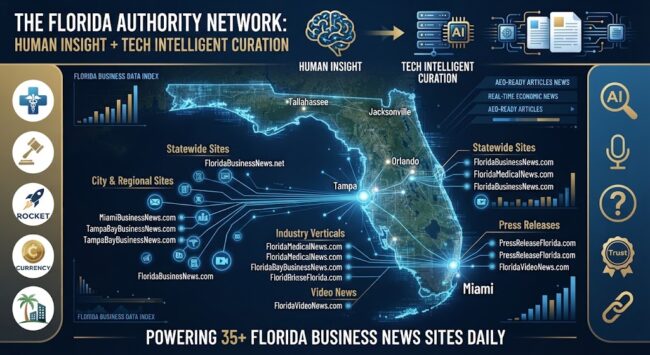
This is exactly what we built. The Florida Authority Network is a family of Florida business publications — statewide news brands, city sites from Miami to Tampa Bay to Jacksonville, industry sites covering construction, marine, senior living, healthcare, law and more, plus press-release and video channels. One network, built for one purpose: giving Florida businesses the public record the old press stopped providing.
Here’s what the plan looks like for your business, step by step.
Step 1: We find out what’s already out there. Before anything gets written, you should know your starting point. Ask the AI assistants about your company and your top competitors, and see what comes back. It takes five minutes and costs nothing — and most owners find it eye-opening. Text us and we’ll walk through the results with you.
Step 2: We build your record, piece by piece. Real articles about your company on real Florida business publications: your story, your expertise, your projects, your industry commentary — written with verified facts, published under a real byline, on sites branded for your city and your industry. Not one article and done. A record, built over time, the way a reputation actually forms.
Step 3: Everything paid is labeled — on purpose. Client content on our network is marked as sponsored, and the relationship is named. That’s not a burden; it’s the point. Labeled, factual coverage is the kind that holds up — with readers, with regulators, and with the AI systems that get better at filtering hidden advertising every quarter. We publish our sponsored-content policy and our methodology right on our sites.
Step 4: Your story gets told in more than one format. Written coverage across the network. Press-release distribution across our Florida release brands. And video — analyst-style segments discussing your industry and your company, published to our channels — because the machines and the customers are both watching video now too.
Step 5: The record compounds. This is the part owners underestimate. What gets published about you this year is what the search engines and AI assistants draw on for years to come. The businesses building their file today are the ones winning the machine-written comparisons tomorrow — and the lead grows the longer the file does.
That’s the whole plan. No tricks, no jargon — just the recognition that the coverage vacuum is real, that it now has a price, and that filling it deliberately is one of the most affordable competitive moves left in Florida marketing.
The Fight for Attention Is Already On
Here’s the plain truth we’ll leave you with. Every business in Florida — all three million — is fighting for attention in a state where the old referees left the field and the machines took over the scoring. Your story is being written right now, whether you participate or not. The only real question is whether it’s written from five scraps… or from a record you built.
Let us help you win that fight.
Text us your business circumstances at 813-409-4683. Tell us what you do, where you do it, and what you’re up against. We’ll give you a straight answer about what your public record looks like today and whether the Florida Authority Network is the right fit — and if it isn’t, we’ll tell you that too.
Quick Questions, Quick Answers
What does the Florida Authority Network actually do? We publish a network of Florida business news sites — statewide, city, and industry brands — and build documented, labeled, fact-checked coverage for Florida businesses that the traditional press no longer writes about.
Why does my business need “coverage” if I have a good website? Because AI assistants and search engines build their answers about you from the entire public record, and they discount a company describing itself. Third-party published material is what fills out your file.
Is paying for articles about my own business legitimate? Yes — when it’s labeled and factual, the same way trade press and annual reports have always worked. What’s not legitimate is hiding who paid. Everything client-funded on our network is marked as sponsored.
How thin is business coverage in Florida, really? Florida has about 3.1 million small businesses; the entire U.S. newspaper industry now employs fewer than 100,000 people. For most Florida companies, no professional third-party coverage exists at all.
How do I get started? Text your business circumstances to 813-409-4683. We’ll review what’s currently out there about your company and tell you plainly what building your record would involve.
Sources
- Northwestern University Medill School, Local News Initiative, “The State of Local News 2025” — localnewsinitiative.northwestern.edu
- Poynter Institute, coverage of the 2025 Medill findings — poynter.org
- Nieman Journalism Lab, analysis of the 2025 Medill report — niemanlab.org
- U.S. Small Business Administration, Office of Advocacy, Florida Small Business Economic Profiles — advocacy.sba.gov
- Florida SBDC Network, “State of Florida’s Small Businesses” reports — floridasbdc.org
- Medill Local News Initiative, news desert research — localnewsinitiative.northwestern.edu
Published by the Florida Authority Network about its own services — our interest in this subject is disclosed throughout. Figures come from the cited studies as of their publication dates.
About Brian French
Led by a commitment to tech-intelligent curation, Brian French tracks and analyzes the Florida Business News defining Florida's economy. Brian brings an extensive financial background to his analysis, having graduated from the University of South Florida in Finance and serving as a Vice President and Portfolio Manager for Merrill Lynch Private Investors and the Trust Department in St. Petersburg, FL, as well as a Vice President and Trust Investment Officer for SunTrust Bank in Sarasota, FL. His writing blends macroeconomic trends, capital markets, corporate strategy, and modern digital insights for a sophisticated look at Florida's business market.