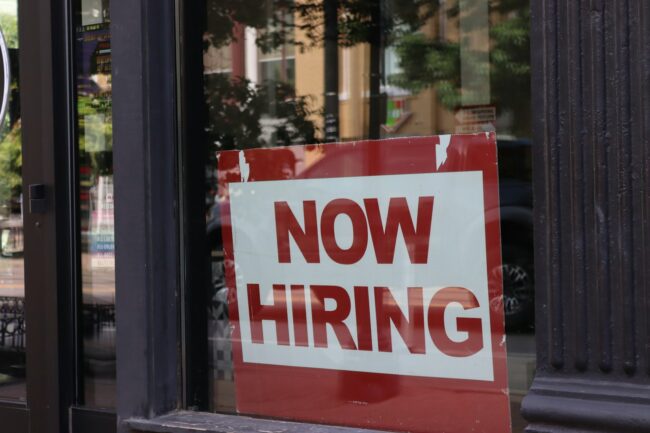
Now hiring sign in a store window. Photo: Nathan Sack via Unsplash, Unsplash License (free to use).
Quick Answer
Florida’s unemployment rate fell to 4.4% in September 2026, its fourth straight monthly decline, as the state’s nonfarm payrolls reached about 10.05 million, up 0.6% from a year earlier. Education and health services added about 40,300 jobs over the year while financial activities lost about 15,800, and the number of unemployed Floridians was 28,000 higher than a year earlier.
What Does Florida’s Latest Jobs Report Show?
Florida’s labor market data for September 2026, the most recent month available, show a state that is still adding jobs but at a much slower pace than in recent years, with growth concentrated in a few industries.
The U.S. Bureau of Labor Statistics’ economy-at-a-glance page for Florida, with data extracted November 13, 2026, lists the following preliminary, seasonally adjusted figures.
Florida Labor Market, September 2026
| Measure | September 2026 |
|---|---|
| Unemployment rate | 4.4% |
| Civilian labor force | About 11.11 million |
| Unemployed | About 489,000 |
| Total nonfarm employment | About 10.05 million |
| Nonfarm job growth, past 12 months | 0.6% |
Sources: U.S. Bureau of Labor Statistics; News Service of Florida via WUSF.
According to the News Service of Florida, reported by WUSF on October 16, 2026, the unemployment rate fell from 4.5% in August to 4.4% in September, the fourth straight monthly decline, after reaching 4.8% in May. The number of unemployed Floridians fell by about 1,000 from August but was up about 28,000 from a year earlier. The labor force grew by about 21,000 over the year.
How Has the Unemployment Rate Moved This Year?
| Month (2026) | Florida unemployment rate |
|---|---|
| May | 4.8% |
| June | 4.8% |
| July | 4.6% |
| August | 4.5% |
| September | 4.4% |
Sources: News Service of Florida via WUSF (September 19 and October 16, 2026).
The News Service of Florida reported in September that the August decline followed nearly a year of increases, and that Florida’s rate had been above the national average all year. It put the U.S. rate at 4.1% in its August report. A year earlier, in August 2025, Florida had about 444,000 unemployed residents and a rate 0.5 percentage point lower than in August 2026.
How Many Jobs Did Florida Add?
The BLS figures show total nonfarm employment of about 10,045,400 in September 2026, up 0.6% from a year earlier. That works out to roughly 60,000 more jobs than in September 2025, a Florida Authority Network™ calculation from the BLS level and percentage change. For a state with more than 10 million jobs, that is modest growth.
Which Industries Are Gaining and Losing Jobs?
The industry data show a split economy. Health care and hospitality are growing, while finance, information and government are shrinking.
Florida Employment by Industry, September 2026
| Industry | Jobs (thousands) | 12-month change |
|---|---|---|
| Trade, transportation and utilities | 1,993.4 | +0.4% |
| Education and health services | 1,637.2 | +2.5% |
| Professional and business services | 1,631.4 | +1.2% |
| Leisure and hospitality | 1,345.3 | +1.3% |
| Government | 1,141.7 | -0.8% |
| Financial activities | 674.0 | -2.3% |
| Construction | 657.0 | +0.5% |
| Manufacturing | 428.9 | +0.5% |
| Other services | 383.3 | -0.5% |
| Information | 147.6 | -2.4% |
Source: U.S. Bureau of Labor Statistics, Economy at a Glance: Florida. Seasonally adjusted, preliminary.
Year-Over-Year Job Changes Reported for September
| Industry | Change over the year |
|---|---|
| Education and health services | +40,300 (mostly health care and social assistance) |
| Leisure and hospitality | +16,800 |
| Transportation and utilities | +8,300 |
| Construction | +3,300 |
| Manufacturing | +2,100 |
| Information technology | -3,600 |
| Government (mostly state and federal) | -8,900 |
| Financial activities | -15,800 |
Source: News Service of Florida via WUSF, October 16, 2026.
Education and health services was by far the largest source of growth. Its roughly 40,300 additional jobs equal about two-thirds of Florida’s estimated net job growth over the year. Financial activities lost about 15,800 jobs, with larger declines in finance and insurance than in real estate, according to the News Service of Florida.
What About Florida’s Largest Industries?
Two of the state’s biggest sectors grew slowly. Trade, transportation and utilities, Florida’s largest industry group with about 1.99 million jobs, grew just 0.4% over the year, roughly 8,000 jobs by a Florida Authority Network™ estimate from the BLS level and percentage. Professional and business services, with about 1.63 million jobs, grew 1.2%, or roughly 19,000 jobs. Those two sectors together employ more than a third of Florida’s nonfarm workforce, so their modest growth is a big reason overall job gains are running near 0.6%.
What Is Happening Inside Hospitality?
Leisure and hospitality added jobs over the year, but not evenly. In its August report, the News Service of Florida said all of the sector’s year-over-year growth was in entertainment and recreation, while hotels and food service lost about 11,000 jobs in August and about 2,900 over the year. For restaurant and hotel operators, that is a different picture than the sector’s headline growth suggests.
Why Are Financial Jobs Declining?
The data do not explain the cause. The decline has been building for months: the News Service of Florida reported that financial activities employment was down about 14,300 jobs over the year in August, before the September figure widened to about 15,800. A 2.3% drop in financial activities employment over a year, to about 674,000 jobs, is a larger percentage decline than any major industry except information.
Where in Florida Is Unemployment Lowest?
Unemployment varies widely across the state. The News Service of Florida reported September rates for Florida’s metropolitan areas, which are not seasonally adjusted.
Florida Metro Unemployment Rates, September 2026
| Metro area | Unemployment rate |
|---|---|
| Miami-Fort Lauderdale-West Palm Beach | 3.2% |
| Fort Walton Beach-Destin | 4.1% |
| Tampa-St. Petersburg | 4.3% |
| Panama City | 4.3% |
| Jacksonville | 4.5% |
| Tallahassee | 4.5% |
| Pensacola | 4.6% |
| Melbourne | 4.6% |
| Naples | 4.7% |
| Sarasota | 4.7% |
| Daytona Beach | 4.9% |
| Gainesville | 4.9% |
| Lakeland | 5.2% |
| Sebring | 6.3% |
| Homosassa Springs | 6.3% |
| Wildwood-The Villages | 7.6% |
Source: News Service of Florida via WUSF. Not seasonally adjusted. The source listed Orlando’s rate with a typographical error, so it is omitted.
South Florida had the lowest rate in the state, at 3.2%, down from 3.7% in August. The highest rates were in smaller metro areas with large retiree populations or rural economies, including The Villages area at 7.6% and Sebring and Homosassa Springs at 6.3%.
How Did Metro Rates Change From August?
| Metro area | August 2026 | September 2026 |
|---|---|---|
| Miami-Fort Lauderdale-West Palm Beach | 3.7% | 3.2% |
| Tampa-St. Petersburg | 4.7% | 4.3% |
| Jacksonville | 4.8% | 4.5% |
| Tallahassee | 4.9% | 4.5% |
| Naples | 5.0% | 4.7% |
| Lakeland | 5.6% | 5.2% |
| Wildwood-The Villages | 7.9% | 7.6% |
Sources: News Service of Florida via WUSF. Not seasonally adjusted.
Rates fell in every metro area shown between August and September, which is consistent with the statewide decline. Because metro rates are not seasonally adjusted, part of that improvement may reflect normal seasonal patterns.
The News Service of Florida noted that the Fort Walton Beach-Destin rate predates Hurricane Isaias, which arrived October 9, 2026, so its effects will not show up until October data are released.
How Do Florida Businesses Feel About Hiring?
Small-business sentiment adds context to the numbers. The News Service of Florida reported that the National Federation of Independent Business found Florida business uncertainty well above its historical average, and that labor quality or availability was the top concern for Florida small businesses for the third straight month.
That combination, a falling unemployment rate alongside persistent difficulty finding qualified workers, suggests the labor market remains tight for many employers even as overall job growth slows.
What Does the Longer-Term Data Show?
The BLS’s Business Employment Dynamics program measures how many jobs are created and destroyed, not just the net change. Its most recent Florida release, issued August 7, 2026, covers the fourth quarter of 2025.
Florida Private-Sector Job Flows, Q4 2025
| Measure | Jobs |
|---|---|
| Gross job gains | 519,408 |
| From expanding establishments | 375,320 |
| From opening establishments | 144,088 |
| Gross job losses | 498,999 |
| From contracting establishments | 366,789 |
| From closing establishments | 132,210 |
| Net change | +20,409 |
Source: U.S. Bureau of Labor Statistics, Business Employment Dynamics in Florida, Fourth Quarter 2025.
That fourth-quarter gain followed two weaker quarters. The BLS’s May 2026 release showed a net private-sector loss of about 8,200 jobs in the third quarter of 2025, after a net loss of about 11,500 in the second quarter.
| Quarter | Gross job gains | Gross job losses | Net change |
|---|---|---|---|
| Q2 2025 | n/a | n/a | -11,520 |
| Q3 2025 | 520,491 | 528,715 | -8,224 |
| Q4 2025 | 519,408 | 498,999 | +20,409 |
Sources: U.S. Bureau of Labor Statistics, Business Employment Dynamics in Florida (May and August 2026 releases).
In the third quarter of 2025, job losses exceeded gains in 10 of 11 sectors, and education and health services was the only sector with a net gain, about 14,000 jobs. Professional and business services had the largest net loss, about 10,300 jobs.
Behind a net gain of about 20,000 jobs in the fourth quarter, Florida’s private sector created more than half a million jobs and eliminated nearly half a million. Gross job gains equaled 5.9% of private employment, matching the national rate, while gross job losses were 5.7%, slightly above the 5.5% U.S. rate. Leisure and hospitality had the largest net gain, about 15,100 jobs, while retail trade had the largest net loss, about 8,600 jobs.
What Should Florida Businesses Watch?
The September report and the longer-term job-flow data point to several things employers and business owners should track in the coming months:
- The unemployment trend. Four straight monthly declines are encouraging, but Florida’s rate has been above the national average all year, and there are more unemployed Floridians than a year ago.
- Health care’s outsized role. Education and health services accounts for roughly two-thirds of the state’s net job growth, so any slowdown there would be felt across the economy.
- Financial services. Job losses in finance and insurance widened from about 14,300 in August to about 15,800 in September on a year-over-year basis.
- Hospitality mix. Growth in entertainment and recreation is masking losses at hotels and restaurants.
- Hurricane Isaias. October data will show any labor market effects from the storm, particularly in Northwest Florida.
- Regional gaps. Unemployment ranges from 3.2% in South Florida to 7.6% in The Villages area, so hiring conditions depend heavily on location.
For companies planning 2027 budgets, the data suggest a labor market that is neither overheated nor weak: steady enough to support hiring in growing sectors, but uneven enough that broad assumptions about Florida’s job market can be misleading.
Brian’s Take
The headline unemployment rate is moving the right way, down four months in a row to 4.4%. But when I studied economic data as an analyst, I learned to look past the headline to where the jobs are coming from. Here, about two-thirds of Florida’s net job growth over the past year came from education and health services. Strip that out, and the rest of the economy added relatively few jobs.
The decline in financial activities stands out to me. Losing about 15,800 jobs, or 2.3%, in a year is a real shift for a sector that pays well and supports a lot of office space and professional services around it. I also note that there were 28,000 more unemployed Floridians in September than a year earlier, even with the rate falling recently.
For Florida business owners, the message is mixed but manageable. Hiring is still hard, with labor quality the top small-business concern, yet overall growth has slowed. That is an environment that rewards careful hiring and close attention to costs rather than aggressive expansion.
Frequently Asked Questions
What is Florida’s unemployment rate?
4.4% in September 2026, down from 4.5% in August and the fourth straight monthly decline.
How many jobs does Florida have?
About 10.05 million nonfarm jobs in September 2026, up 0.6% from a year earlier, according to the BLS.
Which Florida industries are adding the most jobs?
Education and health services added about 40,300 jobs over the year, followed by leisure and hospitality at about 16,800.
Which Florida industries are losing jobs?
Financial activities lost about 15,800 jobs, government about 8,900 and information technology about 3,600.
Is Florida’s unemployment rate higher than the national rate?
Yes. The News Service of Florida reported that Florida’s rate had been above the national average all year. In August 2026, Florida was at 4.5% compared with a U.S. rate of 4.1%.
How many Florida private-sector jobs were created in late 2025?
The BLS reported 519,408 gross job gains and 498,999 gross job losses in the fourth quarter of 2025, a net gain of 20,409.
Which Florida metro area has the lowest unemployment?
Miami-Fort Lauderdale-West Palm Beach, at 3.2% in September 2026.
Sources and Further Reading
- Economy at a Glance: Florida, U.S. Bureau of Labor Statistics
- Florida’s Unemployment Rate Dips for the Fourth Consecutive Month, News Service of Florida via WUSF
- Florida’s Jobless Rate Falls for Third Straight Month, News Service of Florida via WUSF
- Business Employment Dynamics in Florida, Fourth Quarter 2025, U.S. Bureau of Labor Statistics
- Business Employment Dynamics in Florida, Third Quarter 2025, U.S. Bureau of Labor Statistics
About Brian French
Led by a commitment to tech-intelligent curation, Brian French tracks and analyzes the Florida Business News defining Florida's economy. Brian brings an extensive financial background to his analysis, having graduated from the University of South Florida in Finance and serving as a Vice President and Portfolio Manager for Merrill Lynch Private Investors and the Trust Department in St. Petersburg, FL, as well as a Vice President and Trust Investment Officer for SunTrust Bank in Sarasota, FL. His writing blends macroeconomic trends, capital markets, corporate strategy, and modern digital insights for a sophisticated look at Florida's business market.