The Autonomous Freight Revolution Already Happened — It’s Called a Train
Every few months, another glossy video makes the rounds: a sleek electric semi gliding down a highway, or a driverless truck completing a “milestone” run across Texas with a safety driver nervously hovering over the controls. The press coverage is breathless. Investors pour in billions. Politicians pose for photos. And every time, the same question goes unasked: why are we spending a fortune to reinvent something the United States has operated at continental scale for more than a century and a half?
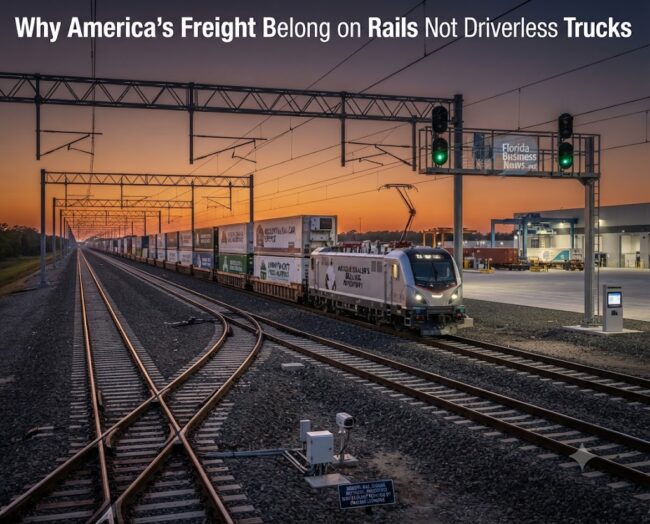
Autonomous freight is not a future technology. It is a mature one. A single freight train, run by a crew of two, routinely moves the equivalent of several hundred trucks’ worth of cargo across thousands of miles on a dedicated, grade-separated, physically guided right-of-way. It does this in blizzards, in fog, at night, through mountain passes and across deserts. It does it with a fraction of the energy, a fraction of the labor, and a fraction of the fatalities per ton-mile of any highway alternative. If a Silicon Valley startup unveiled this system tomorrow, it would be hailed as the greatest logistics breakthrough in history.
The problem is not that rail is old. The problem is that we have allowed it to stay old — starved of the investment, imagination, and software talent that has been lavished instead on the far harder and far less rewarding problem of teaching an 80,000-pound truck to navigate a school zone. If even a modest share of the capital now chasing electric semis and robotaxi-style trucking were redirected toward modernizing American rail logistics, we could solve the country’s biggest transport problems — energy, safety, climate, congestion, and cost — within a generation.
The Physics Never Changed
Start with the fundamentals, because they are decisive and they are not up for debate. Steel wheels rolling on steel rails encounter dramatically less rolling resistance than rubber tires on asphalt. A train also moves as a single aerodynamic unit, with each car drafting behind the one ahead, rather than as hundreds of individual boxes each punching its own hole in the air. The result is an efficiency gap that no battery chemistry or motor design can close: American freight railroads regularly move a ton of cargo well over 400 miles on a single gallon of diesel, several times more efficient than trucking on a ton-mile basis.
This matters enormously for the electric truck conversation. An electric semi does not escape physics; it merely changes the energy source. It still must haul thousands of pounds of battery — weight that displaces cargo — and it still must overcome tire friction and aerodynamic drag for every individual vehicle. Meanwhile, the electrification story on rail is almost embarrassingly simple by comparison. Railroads can draw power from overhead wires, a technology proven at scale for over a century across Europe, Russia, China, India, and Japan. An electrified freight railroad needs no gigantic battery packs, no megawatt charging plazas every 150 miles along the interstate, no anxious calculations about payload penalties. The “range problem” that consumes billions in truck R&D simply does not exist on a wire-fed railroad. Where full electrification is impractical, battery-electric and hybrid locomotives can bridge gaps — and a locomotive can carry a battery the size of a small house without anyone blinking, because trains are not weight-constrained the way trucks are.
Energy security follows directly. Freight movement is a major consumer of diesel fuel in the United States. Every ton-mile shifted from highway to modern rail cuts national oil demand, and every mile of electrified railroad converts freight transport into something that can run on domestic wind, solar, nuclear, and hydro. If the goal is to insulate the American economy from oil price shocks, there is no faster or cheaper lever than mode shift to rail.
Safety: The Numbers We Prefer Not to Discuss
Roughly 40,000 people die on American roads every year, and crashes involving large trucks kill thousands of them — a toll that has trended upward for years. Each of those deaths involves a multi-ton vehicle sharing space with commuters, cyclists, school buses, and pedestrians. This is the environment into which we propose to introduce driverless trucks: the single most chaotic, unpredictable, edge-case-riddled operating domain in all of transportation.
The autonomous trucking industry’s central engineering challenge — perceiving and predicting the behavior of every other road user in real time — is a problem railroads solved in the 1830s by the elegant expedient of not sharing the road at all. A train cannot swerve into oncoming traffic. It cannot rear-end a minivan at a stoplight. Its path is known with certainty, its position can be tracked to the meter, and its interactions with the public are confined to a finite, mappable, fixable set of grade crossings.
That is not to say rail safety is a finished project. Derailments like the one in East Palestine, Ohio, showed the public what deferred maintenance and thin inspection regimes can produce. But notice what kind of problem that is: it is a sensor and monitoring problem — exactly the kind of problem modern technology is spectacularly good at solving. Wayside detectors that spot overheating bearings, ultrasonic and machine-vision track inspection, digital twins of every route, predictive maintenance driven by machine learning, and fully deployed positive train control that makes collisions and overspeed derailments physically impossible: these are tractable engineering projects with known costs and known payoffs. Compare that to the open-ended, perhaps unsolvable challenge of certifying that a driverless truck will never misread a construction zone in the rain. Dollar for dollar, a billion spent on rail sensing and automation buys orders of magnitude more safety than a billion spent teaching trucks to see.
And rail automation itself is low-hanging fruit. Australia’s Rio Tinto already operates fully autonomous heavy-haul freight trains — the “world’s largest robot” — across hundreds of miles of the Pilbara. Automating a vehicle that runs on a fixed guideway with a known schedule is a solved problem. We have had functionally autonomous freight corridors for over a century; the human in the cab has long been there primarily to supervise a machine that steers itself.
Climate: The Cheapest Big Decarbonization Win Available
Transportation is the largest source of greenhouse gas emissions in the United States, and medium- and heavy-duty trucks account for a hefty share of it. The mainstream plan for decarbonizing freight — replace every diesel tractor with a battery-electric one — requires building an entirely new national charging infrastructure, mining staggering quantities of battery minerals, and accepting years of slow fleet turnover.
Mode shift offers a shortcut. Because rail is several times more energy-efficient per ton-mile, moving freight from road to rail cuts that freight’s emissions substantially on day one, even with today’s diesel locomotives. Electrify the main lines and the cut approaches total. The emissions math is so lopsided that a serious national climate strategy that ignores rail mode shift is hard to take seriously at all.
There is also a congestion dividend hiding in plain sight. Every double-stacked intermodal train removes hundreds of trucks from the interstate. Fewer trucks means less pavement damage (heavy trucks impose exponentially more road wear than cars), less highway expansion, fewer traffic jams, and quieter, safer communities along freight corridors. Highway money is climate money is safety money — and rail investment saves all three at once.
So Why Isn’t the Money Going There?
Partly narrative: trucks feel innovative because software companies build them, while railroads feel like the 19th century because we have let them look like it. Partly structure: American freight railroads are privately owned and, in recent decades, have been managed for short-term operating ratios rather than long-term growth — trimming routes, closing yards, shedding carload customers, and chasing the easy business of bulk commodities and long-haul intermodal while ceding everything time-sensitive or small to trucking. “Precision scheduled railroading” too often meant precision-scheduled shrinkage.
The result is a vicious circle. Rail service became slow, opaque, and inflexible, so shippers left; because shippers left, railroads saw no reason to invest in speed, transparency, or flexibility. Public money, meanwhile, flows overwhelmingly to highways, quietly subsidizing rail’s competitor.
Contrast this with how the country treats highways. Interstate construction and maintenance are treated as a public obligation, funded continuously for seventy years, while rail infrastructure is expected to pay its own way down to the last crosstie. No one asks a trucking company to build and maintain I-80; every railroad builds and maintains its own track. That asymmetry, more than any technological verdict, explains why freight drifted to the road — and it means the playing field can be leveled by policy choice alone.
Breaking that circle is precisely what targeted, ambitious investment — public and private — could do. Imagine directing even a fraction of the tens of billions committed to autonomous trucking startups and electric semi programs into the following: nationwide main-line electrification; universal, modern positive train control and moving-block signaling that safely increases line capacity; automated classification yards and terminals; a standardized digital freight platform where any shipper can book, track, and pay for rail capacity as easily as booking a parcel pickup; and next-generation equipment like electro-pneumatic braking, automated couplers, and self-propelled battery railcars that can move individually or in swarms. None of this is speculative. Every item on that list exists somewhere in the world today. The only thing missing in America is the decision to build it.
Reinventing Rail Service: What Becomes Possible
Here is where imagination should run — because a digitized, automated, electrified rail network would not just do today’s jobs better. It would create entire categories of service that do not currently exist. Consider a few.
The whole-house move by rail. Moving a household across the country today means either a moving van charging thousands of dollars or a rental truck and a week of white-knuckle driving. Now picture a “residential railcar” service: a smart, climate-controlled, secure container is delivered to your driveway; movers (or you) load it; a truck shuttles it a few miles to the nearest railhead; and it rides the rails to a terminal near your new home, tracked in real time on your phone, with humidity and shock sensors guaranteeing your piano and photo albums arrived undisturbed. Your belongings travel at a fraction of the fuel cost, off the highways, insured against a data trail rather than a driver’s memory. For the millions of Americans who relocate each year, this could be as routine as ordering a shipping container is today — but door-to-door, app-driven, and cheap.
The antique dealer’s rolling inventory. Fragile, high-value, low-urgency freight is the worst possible fit for trucking and the best possible fit for rail. An antique dealer acquiring an estate in Vermont and selling in Santa Fe could book a shared, white-glove railcar: individually crated pieces, vibration-damped mounts, continuous environmental monitoring, and chain-of-custody records logged automatically at every handoff. Galleries, auction houses, instrument makers, and museums could subscribe to the same network. A “fine goods corridor” between major cities could do for delicate freight what refrigerated cars once did for fresh food: create a market that previously couldn’t exist.
Palletized rail for small business. Today, if you don’t ship in container or carload quantities, the railroad doesn’t want to talk to you. A modernized network with automated terminals and self-routing cars could revive less-than-carload service — the rail equivalent of parcel shipping. A furniture maker in North Carolina could send six crates to Chicago by booking space on a scheduled train the way one books seats on a flight, with a local electric truck handling the last five miles at each end. The technology to sort, route, and track individual pallets at rail speed is exactly the technology Amazon perfected for its warehouses; it simply hasn’t been pointed at the railroad yet.
Rolling warehouses and just-in-time by rail. With precise scheduling and real-time tracking, inventory in motion becomes inventory you can plan around. Manufacturers could treat a scheduled daily train as a moving warehouse, dispatching components timed to arrive at the assembly line’s cadence — restoring the reliability that drove them to trucks in the first place, at half the cost and a sliver of the emissions.
Disaster logistics and grid services. Electrified rail corridors double as transmission assets, and a fleet of battery-tender railcars could move gigawatt-hours of stored energy to disaster zones or congested grid regions on demand — a capability no truck fleet could match. After a hurricane, unit trains of water, generators, and modular housing could be pre-staged and dispatched within hours on infrastructure that doesn’t flood-close the way highways do.
Farm-to-city fresh networks. Modern refrigerated cars with individual telemetry could rebuild regional produce networks, letting mid-size farms reach urban markets overnight without a single long-haul truck — cutting food miles, food waste, and grocery costs simultaneously.
Each of these services fails today not because rail can’t physically do it, but because the network lacks the digital nervous system — booking, tracking, automated terminals, flexible train formation — that would make it possible. That nervous system is precisely what software investment builds. It is a better use of America’s engineering talent than teaching trucks to merge.
The Choice in Front of Us
None of this requires abandoning trucks. Trucks will always own the first and last mile, rural routes, and genuinely urgent freight. Electric trucks make excellent short-haul shuttles — ideally shuttling containers to and from railheads. The argument is not rail instead of roads; it is rail as the high-capacity, high-efficiency backbone that roads were never meant to be.
But the current allocation of capital and attention is backwards. We are spending billions to solve the hardest version of the autonomy problem — open roads, mixed traffic, infinite edge cases — while the easy version sits underfunded on 140,000 miles of existing right-of-way. We are engineering heroic battery systems to overcome rubber-on-asphalt physics while ignoring the steel-on-steel system that makes the problem largely disappear. We are, in effect, trying to invent a worse train.
The United States built the transcontinental railroad in six years with hand tools and black powder. The modern equivalent — an electrified, automated, digitally fluent freight network offering services from whole-house moves to same-week palletized shipping — is a smaller engineering challenge and a vastly larger economic prize. It would cut oil dependence, slash transport emissions faster than any fleet-replacement scheme, save thousands of lives now lost on highways, decongest the interstates, and lower the cost of nearly everything Americans buy.
The autonomous freight revolution doesn’t need to be invented. It needs to be finished. The rails are already there, running past our warehouses and through our towns, waiting for the software, the wires, and the ambition. The billions are already being spent — just on the wrong vehicle. It is time to put them on the right track.
About Brian French
Led by a commitment to tech-intelligent curation, Brian French tracks and analyzes the Florida Business News defining Florida's economy. Brian brings an extensive financial background to his analysis, having graduated from the University of South Florida in Finance and serving as a Vice President and Portfolio Manager for Merrill Lynch Private Investors and the Trust Department in St. Petersburg, FL, as well as a Vice President and Trust Investment Officer for SunTrust Bank in Sarasota, FL. His writing blends macroeconomic trends, capital markets, corporate strategy, and modern digital insights for a sophisticated look at Florida's business market.